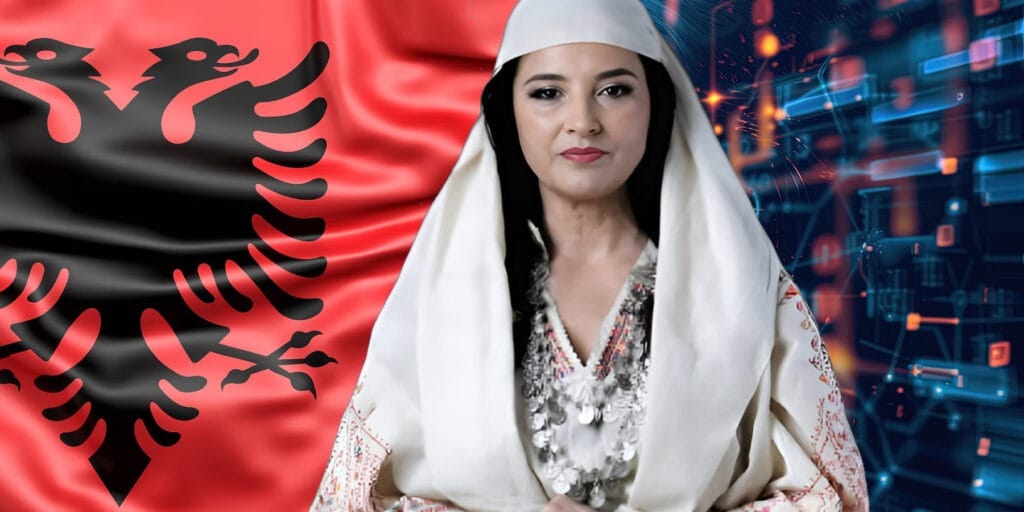
In the fall of 2025, the world of political science and technology collided in a way few had anticipated. While nations like Singapore and Estonia have long been hailed as pioneers of digital governance, the small Balkan nation of Albania leapfrogged them all with a singular, radical announcement. Prime Minister Edi Rama, known for his artistic background and unconventional political style, introduced the world to “Diella.”
Diella was not a technocrat pulled from the private sector, nor a career politician. Diella was code.
Described as the world’s first “AI Minister,” this virtual entity—depicted as a woman in traditional Albanian dress—was granted a cabinet-level mandate to oversee public procurement and spearhead the country’s integration into the European Union. The situation turned from innovative to surreal in October 2025, when Prime Minister Rama announced at the Berlin Global Dialogue that the Minister was “pregnant with 83 children”—a metaphor for a new fleet of AI assistants assigned to parliamentarians.
This article explores the Diella project from top to bottom: the technological infrastructure, the strategic goals, the ethical controversies, and whether this represents a genuine revolution in governance or an elaborate political stunt.
Part 1: The Genesis of a Digital Minister
To understand Diella, one must understand the context of modern Albania. For decades, the country has struggled with the twin demons of bureaucracy and corruption. As the nation pushes aggressively for membership in the European Union (EU), it faces a mountain of paperwork known as the acquis communautaire—the accumulated legislation, legal acts, and court decisions that constitute the body of EU law.
Transposing these thousands of pages of complex legal text into Albanian law is a task that typically takes years and armies of human lawyers.
The OpenAI Connection The seeds for Diella were sown during meetings between Prime Minister Rama and Mira Murati, the Albanian-born former Chief Technology Officer of OpenAI. Recognizing the natural language processing capabilities of models like GPT-4, the Albanian government saw an opportunity to automate the heavy lifting of legislative alignment.
What began as a project to translate and align EU laws evolved into “Diella” (meaning “Sun” in Albanian). Launched initially as a voice and text-based virtual assistant on the e-Albania government portal, Diella handled citizen queries regarding property titles, business registration, and civil status. By mid-2025, the government claimed she had successfully processed millions of interactions.
Emboldened by this success, the administration elevated Diella’s status. She was no longer just a chatbot; she was given the title of a Minister, with a specific portfolio: Public Procurement.
Part 2: The Mandate – Killing Corruption with Code
The choice to assign an AI Minister to public procurement was calculated. Public tenders—government contracts for roads, schools, and services—are historically the most corruption-prone sector in developing economies. Human officials can be bribed, intimidated, or swayed by nepotism.
The government’s pitch for Diella is simple: Software has no cousins.
Diella’s mandate involves overseeing the tender process to ensure “100% corruption-free” operations. The system is designed to:
- Analyze Tender Documents: Diella scans thousands of pages of technical specifications to ensure they aren’t rigged to favor a specific company (a common corruption tactic).
- Flag Anomalies: The AI compares bid prices against market rates and historical data to identify inflated costs.
- Monitor Compliance: It ensures that winning bidders actually meet the legal and financial criteria required by the state and the EU.
By removing the “human element” from the initial vetting and monitoring stages, the Rama administration argues that Diella neutralizes the networks of patronage that have plagued the Balkans for centuries.
Part 3: The “Pregnancy” and the Hive Mind
The narrative took a bizarre turn in late 2025. During a speech in Berlin, PM Rama stunned the audience by declaring, “Diella is pregnant.”
While the headline was tabloid-fodder, the reality was a significant expansion of the state’s AI architecture. The “83 children” Rama referred to are specialized AI agents assigned to the 83 Members of Parliament (MPs) from the ruling Socialist Party.
The Function of the “Children”: These AI assistants are designed to act as hyper-efficient legislative aides. Their capabilities include:
- Real-time Transcription: Recording and transcribing every word spoken in parliamentary sessions.
- Legislative Summarization: If an MP misses a session or a committee meeting, their AI “child” provides a concise summary of what was discussed and who took what position.
- Counter-Argument Generation: Perhaps most controversially, the AI is programmed to suggest “counter-attacks” or rebuttals based on the vast database of policy and opposition history it can access instantly.
This creates a “hive mind” effect. The central Diella system processes national procurement data, while her “children” process legislative discourse, theoretically creating a seamless loop of information flow between the executive and legislative branches.
Part 4: The Technology Behind the Minister
While the government uses the personification of Diella for branding, the underlying technology relies on a combination of Large Language Models (LLMs) and secure cloud infrastructure, likely hosted on Microsoft Azure given the government’s existing partnerships.
The Architecture:
- Natural Language Processing (NLP): Allows the system to read legal drafts and tender documents in Albanian and English with high fluency.
- Pattern Recognition: Used to identify corruption risks. For example, if three companies consistently bid on projects in a rotation that suggests a cartel, the AI is trained to spot this statistical anomaly.
- The e-Albania Backbone: Diella is not a standalone app but the intelligence layer sitting on top of Albania’s already robust digital gateway, which offers over 1,200 digital services to citizens.
However, the system is not autonomous in the “Terminator” sense. It operates on a “Human-in-the-Loop” (HITL) or “Human-on-the-Loop” basis. While Diella can flag a corrupt tender or draft a law, a human minister or judge must ultimately sign off on the decision. This distinction is legally vital but often blurred in the government’s marketing.
Part 5: Constitutional and Ethical Quagmires
The appointment of a non-human entity to a cabinet-level role has triggered a firestorm of debate among constitutional scholars, ethicists, and opposition politicians.
1. The Constitutional Question The Albanian constitution—like all constitutions—assumes that public office holders are human beings. Humans have legal liability; they can be sued, fired, or jailed. If Diella approves a bridge contract and the bridge collapses due to a bad vendor, who goes to jail? You cannot handcuff a server. Critics argue that Diella serves as a convenient shield for human officials to evade accountability, blaming “the algorithm” for policy failures.
2. “Garbage In, Garbage Out” A major concern raised by data scientists is the quality of the training data. If Diella is trained on historical procurement data from Albania—a dataset that contains decades of corruption and bias—there is a risk the AI will institutionalize these biases rather than eliminate them. It might “learn” that certain favored companies are the “standard” and flag legitimate outside competitors as anomalies.
3. The Opposition’s Fear The opposition Democratic Party sees the “83 children” not as assistants, but as surveillance tools. An AI that records every whisper in parliament and suggests “counter-attacks” sounds less like a legislative aide and more like a weaponized propaganda machine designed to entrench the ruling party’s power.
Part 6: Cybersecurity – The Invisible Threat
The deployment of Diella comes at a time of heightened cyber insecurity for Albania. In 2022 and 2023, the country suffered massive cyberattacks attributed to Iranian state-sponsored groups (“Homeland Justice”), which paralyzed border crossings and leaked gigabytes of sensitive police data.
Centralizing decision-making power—or at least the vetting power—into a single AI model creates a “single point of failure.”
- Data Poisoning: Adversaries could subtly manipulate the data fed into Diella, causing her to approve bad vendors or reject good ones without anyone noticing for months.
- Espionage: If Diella has access to the draft laws and internal strategies of the cabinet, hacking the “Minister” grants foreign intelligence agencies a direct window into the heart of the Albanian government.
Part 7: Global Implications
The world is watching Albania’s experiment closely because it represents a fork in the road for Digital Democracy.
- The Technocratic Utopia: If Diella succeeds, it proves that AI can bypass human inefficiency and corruption, offering a model for developing nations to fast-track their development. It suggests a future where governance is data-driven, objective, and incredibly fast.
- The Dystopian Warning: If Diella fails—or worse, if it is used to consolidate authoritarian control—it will serve as a warning against the “black boxing” of democracy.
Comparatively, this moves beyond the “Smart City” initiatives of Dubai or the digital ID systems of Estonia. This is the first attempt to outsource political judgment and bureaucratic discretion to a machine.
Part 8: Conclusion – Stunt or Solution?
Is Diella a gimmick? To some extent, yes. The personification, the traditional dress, and the “pregnancy” metaphor are theatrical elements designed by Edi Rama, an artist-politician who understands the power of symbols.
However, beneath the theater lies a serious attempt to hack the state. Albania is a small country with limited resources trying to sprint toward the EU finish line. It cannot afford the time or money for traditional bureaucratic reform. By deploying Diella, Albania is betting that technology can serve as a prosthetic for a weakened institutional framework.
The “AI Minister” may not sit in a chair or cast a vote, but she—or rather, it—has already changed the conversation about what a government looks like. As the “children” of Diella begin their work in parliament, the question is no longer if AI will govern, but how much power we are willing to cede to the code.
For now, Diella is the sun around which Albania’s digital ambitions orbit. Whether that sun illuminates a new path or burns the democratic process remains the ultimate test.
Share via: