This digest compiles the latest from Engadget.
Today’s Engadget Roundup
The Vatican introduces an AI-assisted live translation service
16 Feb 2026, 4:30 pm by Sarah Fielding
The Vatican is leaning into AI. AI-assisted live translations are being introduced for Holy Mass attendees — the holy masses if you will. The Papal Basilica of Saint Peter in the Vatican has teamed up with Translated, a language service provider, to create live translations in 60 languages.
"Saint Peter’s Basilica has, for centuries, welcomed the faithful from every nation and tongue. In making available a tool that helps many to understand the words of the liturgy, we wish to serve the mission that defines the centre of the Catholic Church, universal by its very vocation," Cardinal Mauro Gambetti, O.F.M. Conv., Archpriest of the Papal Basilica of Saint Peter in the Vatican, said in a statement. "I am very happy with the collaboration with Translated. In this centenary year, we look to the future with prudence and discernment, confident that human ingenuity, when guided by faith, may become an instrument of communion."
Visitors to the Vatican will have the option to scan a QR code. They will then have access to live audio and text translations of the liturgy. It doesn't require an app and should work right on a web page.
The technology stems from Lara, a translation AI tool Translated launched in 2024. Translated claims that Lara works with the "sensitivity of over 500,000 native-speaking professional translators."
This article originally appeared on Engadget at https://www.engadget.com/ai/the-vatican-introduces-an-ai-assisted-live-translation-service-163014907.html?src=rss
Layers of 3 revealed via a mysterious trailer and poem
16 Feb 2026, 3:30 pm by Steve Dent
Bloober Team has revealed Layer of Fear 3 following a Valentine's Day countdown that started at the beginning of 2026. The new chapter will include not only a game but a novel and music, the company said in a press release.
The developer revealed the new IP via a live-action teaser, with an actor reading lines from William Blake's poem, The Sick Rose. A painting then fell from the wall, and the actor then turned over an hourglass with red sand, with a tagline stating "The door won't stay closed." No gameplay or other information like the release date was revealed.
What Bloober did say, though, is that it would launch new Layer of Fear non-game content, including a novel by horror writer, poet and vocalist Marta Bijan. The company also announced that it would release the soundtracks for Layer of Fear, The Medium and Cronos both in digital and physical (CD and vinyl) editions.
The new title is likely to be eagerly anticipated given Bloober's form of late. The company recently released its Silent Hill 2 remake, Cronos: The New Dawn and a new Switch 2 Layers of Fear 2 version called Layers of Fear: The Final Masterpiece Edition. The original Layers of Fear came out back in 2016 and is considered one of the better horror titles of recent years, thanks to an expertly crafted narrative and psychedelic thrills and chills. The sequel moved to a creepy ocean liner and was equally well-received.
This article originally appeared on Engadget at https://www.engadget.com/gaming/layers-of-3-revealed-via-a-mysterious-trailer-and-poem-153021903.html?src=rss
Apple's next event is set for March 4
16 Feb 2026, 2:59 pm by Kris Holt

Apple has lined up its first event of the year. The company has invited members of the press to an “Apple Experience” that’s taking place in New York City on March 4 at 9AM ET. It hasn’t yet confirmed whether it will stream the event publicly. According to MacRumors, versions of this Apple Experience will also take place simultaneously in London and Shanghai.
It seems likely that Apple will take this opportunity to unveil its latest slate of iPads and MacBooks. Bloomberg’s Mark Gurman reported earlier this month that Apple was planning to make a number of hardware announcements “as early as the week of March 2.”
This is expected to include a new MacBook Air and refreshed 14- and 16-inch MacBook Pros, with the M5 Pro and M5 Max making their debuts (a MacBook Pro with the base M5 chip arrived in October). There’s also speculation that Apple will announce a new entry-level MacBook that will be available in light yellow, light green, blue and pink colorways.
In addition, we may see new iPads here (or perhaps a little farther down the line), including an entry-level model with an A18 chip that’s capable of supporting Apple Intelligence features. The iPad Air could be in line for an upgrade as well with the introduction of the M4 chip to that line. Apple is also expected to roll out updated versions of the Mac Studio, Studio Display and Mac mini later this year.
This article originally appeared on Engadget at https://www.engadget.com/computing/laptops/apples-next-event-is-set-for-march-4-145931890.html?src=rss
Presidents' Day sales 2026 are live: The best tech deals up to 43 percent off to shop from Apple, Samsung, Anker and others
16 Feb 2026, 2:51 pm by Engadget
Presidents’ Day is a great time to buy appliances, mattresses and furniture as they are often on sale for the holiday. Tech also gets discounted around this time, but you have to do a bit more digging to find actually good deals. And this year, Presidents’ Day comes right after Valentine’s Day and Super Bowl 2026, which means there are some overlapping sales to consider. If you don’t want to sort through the mess of bad deals out there, Engadget has you covered. We’re curating the best President Day sales on tech we can find right here. We’ll update this post through the holiday as more deals become available.
Presidents’ Day deals under $50
Disney+ and Hulu bundle (one month) for $10 ($3 off): You can get one month of Disney+ and Hulu access for only $10 right now. That represents a small savings over the standard $13-per-month price for the bundle, but a 58-percent discount when you compare it to the price of paying for both services separately. It’s a good way to test out the bundle without paying too much before you decide if you want to subscribe for the long haul.
Anker Nano 45W USB-C charger for $30 ($10 off, Prime exclusive): Anker’s latest 45W charger has a small smart display on it that can show you real-time charging stats. It’s compact design is great for travel, as are its foldable prongs.
Waterpik cordless rechargeable water flosser for $40 (20 percent off): A water flosser like this one can make it easier (and less painful in some cases) to floss your teeth on the regular. This model from Waterpik includes two interchangeable tips and has two pressure settings. Its battery life should last up to four weeks with regular use as well.
Amazon Fire TV Stick 4K Max for $40 ($20 off): Amazon’s most premium streaming dongle supports 4K HDR content, Dolby Vision and Wi-Fi 6E. You may even be able to get it for $10 less than the sale price listed, for a final price of $30, when using the code MAX4KFTV at checkout.
Blink Mini 2K+ — 2 cameras for $45 (50 percent off): Blink’s latest plug-in security cameras support 2K video and improved audio quality. Like previous versions, these cameras have two-way talk, motion alerts and support for Alexa voice commands.
Presidents’ Day deals on Apple devices
Apple iPhone Air MagSafe battery pack for $79 (20 percent off): This magnetic power bank will add up to 65 percent additional battery charge to the iPhone Air, but note that it only works with Apple’s new, ultra-slim smartphone. We’ve tested plenty of others that also work with other iPhone and smartphone models.
Apple Magic Mouse for $68 (14 percent off): Apple’s sleek wireless mouse has a multi-touch surface that supports gesture control, and its battery should last about a month in between charges. And yes, it has a USB-C port.
Apple Watch Series 11 for $299 ($100 off): The latest flagship Apple Watch has excellent performance, a boosted battery life and a lightweight design that you can comfortably wear all day long — and even into the night to track sleep.
iPad mini (A17 Pro ) for $399 ($100 off): The updated iPad mini runs on the A17 Pro chip for improved performance, plus it has an 8.3-inch Liquid Retina display, a 12MP ultra wide camera with Center Stage, USB-C charging and compatibility with the Apple Pencil Pro.
Beats Studio Pro for $200 (43 percent off): Beats updated these cans to have improved sound quality, and you can really hear the difference from models that came before it. These headphones also have solid Transparency mode, good voice performance and USB-C audio.
Beats Solo 4 headphones for $150 (25 percent off): These on-ear headphones support spatial audio and dynamic head tracking, and they have up to 50 hours of battery life. The “fast fuel” feature allows them to get up to five hours of playback time with just a quick 10-minute power-up.
Beats Studio Buds+ for $100 (41 percent off): These tiny buds have both active noise cancellation and transparency mode, and they’ll work just as well with either Apple or Android devices.
More Presidents’ Day deals on tech
Ring Battery Doorbell for $60 (40 percent off)
Logitech MX Master 3S for $80 (20 percent off)
Levoit Core 300-P air purifier for $85 (15 percent off)
Sony WH-CH720N wireless headphones for $94 (48 percent off)
Google Pixel Buds Pro 2 earbuds for $179 (22 percent off)
Sonos Beam Gen 2 soundbar for $369 ($130 off)
Hisense 75-inch QD7 Mini-LED 4K smart TV for $548 (16 percent off)
Breville Barista Touch espresso machine for $800 ($200 off)
Motorola Razer Ultra (2025) for $800 (38 percent off)
Google Pixel 10 Pro for $849 (23 percent off)
This article originally appeared on Engadget at https://www.engadget.com/deals/presidents-day-sales-2026-are-live-the-best-tech-deals-up-to-43-percent-off-to-shop-from-apple-samsung-anker-and-others-163000321.html?src=rss
Apple Presidents' Day sales are live: Get the Apple Watch Series 11 for $299, plus more deals to shop now
16 Feb 2026, 2:44 pm by Sarah Fielding
If you need a little help with your New Year's resolution to be more active, you can save on the latest Apple Watch right now. The Apple Watch Series 11 is on sale for $299 for Presidents' Day, which is $100 off and the lowest price we've seen. A number of other Apple devices are on sale for the holiday as well.
We named the Apple Watch Series 11 as our choice for best smartwatch overall. It scored a 90 in our review thanks to its 24 hours-plus of battery life and a thin, light design that's easy to wear. It also offers new health metrics, including Apple's hypertension alerts system and Sleep Score.
The Apple Watch Series 11 deal is available on the 42mm case with a small/medium band. It also only includes GPS and four colorways: the Jet Black and Space Gray aluminum cases with a Black sport band, the Rose Gold aluminum case with a Light Blush sport band and the Silver aluminum case with a Purple Fog sport band.
Among the other Presidents' Day Apple deals are mostly accessories: there are solid deals on AirPods, AirTags (the first-gen trackers, not the new, second-gen ones), the iPhone Air battery pack and even Apple's new crossbody straps that attach to the company's iPhone cases so you can essentially "wear" your iPhone like a bag. As with most Apple first-party accessories, you can find plenty of more affordable, third-party versions of them as alternatives. But if you're keen on outfitting your phone with Apple's own gear, it's best to wait for discounts like these. We've collected the best Presidents' Day sales on Apple gear below so you don't have to go searching for them.
Follow @EngadgetDeals on X for the latest tech deals and buying advice.
This article originally appeared on Engadget at https://www.engadget.com/deals/apple-presidents-day-sales-are-live-get-the-apple-watch-series-11-for-299-plus-more-deals-to-shop-now-151616701.html?src=rss
The creators of Mixtape want to make a great hangout video game
16 Feb 2026, 2:00 pm by Alessandro Fillari
For most adventure games, the long-term goal can often focus on solving a grand mystery or chasing a lost artifact of the past. But for the upcoming Mixtape, from publisher Annapurna Interactive, it sets its sights on the misadventures of young friends enjoying their last days together before moving on. It's the type of narrative adventure game that shines a light on how good music can bring people together, and how much fun getting into trouble can be.
From developer Beethoven and Dinosaur, the Australian creative team behind The Artful Escape, Mixtape is, in many ways, a tribute to classic '90s Americana and an ode to the rebellious youth of the average suburb. I recently got to play the latest build of Mixtape and spoke with game director Johnny Galvatron about the making of their latest game. Along with sharing his favorite '80s and ’90s films that helped shape his vision, he also explained how tough yet rewarding it is to make "idleness" in video games compelling.
"Idleness is hard to explore as a video game, and one of the interesting things about being a teenager is you just hang out a lot, and sometimes it just sucks," said Galvatron. "So I love that we made a game that shows that idleness.”
“I think it can be a really hard balance to make something that is based on what is really a hangout film, something like Wayne's World or Richard Linklater's Dazed and Confused, but to have that be paced well and to be exciting for a video game was a real challenge."
Set in the 1990s, Rockford and her friends Slater and Cassandra prepare for one last hurrah before heading into adulthood. With Rockford deciding to make a daring move to New York City to hopefully connect with her music idol, the crew reminisces on the good times they had going for late-night fast food runs, evading the police in shopping carts, and first kisses with their crushes – and all to the tune of their favorite songs.
On the surface, Mixtape is an interactive coming-of-age story about a crew of rebellious teens, with memories serving as playable mini-games and interludes that capture their feelings at the time. But that's actually what makes this interactive trip down memory lane so compelling. These segments are presented as exaggerated memories of the past, fueled by the music of Devo, Joy Division, and Siouxsie and the Banshees. They’re emotional, poignant moments for these characters, tapping into the idea of how moments from our youth seemed bigger and grander than they actually were.
One section I enjoyed playing was an interactive head-bobbing segment where the crew drove across town to get fast food. Different buttons corresponded to fist-pumping and head-bobbing actions, but there were no specific directions, so I just had to go with the flow. This scene was a great bit of comedy that showed off how goofy Rockford and her friends could get while vibing, but it was also a fun callback to films like Pulp Fiction, which used rear-projection sets to simulate car driving scenes (the memory even plays out on a film set). Another segment focused on a photo booth with Rockford and Slater, which put them in a position to capture the best or funniest shots.
But it's not all fun and games with the crew. One segment focused on the friends tossing toilet paper rolls around their school principal's home, which quickly takes a turn for the worse when one of them decides to take the blame to spare Rockford from expulsion. It's a surprisingly heartfelt and sad moment, but it also foreshadows a simmering conflict for these characters.
It's clear that Mixtape seeks to capture the experiences of a particular era, and that the developers themselves had a particular fondness for American movies and pop culture of the time. It captures the feeling of the so-called MTV generation and the intersection of media and the emotional expression of youth during this period. This is also evident in the game's use of a "mixed media, liquid television" editing style, which intercuts clips from TV shows and movies to emphasize emotional and comedic beats.. Rockford even does a Ferris Bueller-style narration for the players.
Given that video game-to-movie adaptations have never been more popular, game director Johnny Galvatron has also had some talks about a potential movie adaptation.
"Obviously, Annapurna is also a film company, and they have those kinds of connections, and let me tell you, those meetings are fun as fuck," said the director. "When people pitch you stuff, it's super cool. I would just say that, yes, I can see it coming. I would probably be totally hands-off on it."
“When you develop video games, you should be changing them to work better within the medium," he continued. "I think when they try to adhere too closely to the way a game works, that can sometimes break down. But yeah, I think if there were to be some adaptation stuff for Mixtape, probably, and I will stay clear of it."
Mixtape feels like a heartfelt tribute to the '90s. While nostalgia bait is increasingly common these days, I felt there's a much deeper message under the hood, and getting to take part in these larger-than-life days of being a young adult has really got me excited for what's to come. I'm hoping the final game will deliver an adventure where I can really savor those listless hangouts with friends.
Mixtape is set to be released on PC, PlayStation 5, and Xbox Series X|S later this year.
This article originally appeared on Engadget at https://www.engadget.com/gaming/the-creators-of-mixtape-want-to-make-a-great-hangout-video-game-140026928.html?src=rss
Monarch Money deal: Get a 50 percent off one of our favorite budgeting apps
16 Feb 2026, 12:00 pm by Georgie Peru
If you’ve been meaning to get a better handle on your finances, now might be a good time to try one of our favorite budgeting apps without paying full price. Monarch Money is offering new users 50 percent off an annual subscription when you use the code MONARCHVIP at checkout, bringing the cost down to $50 for a full year of access instead of the usual $100.
Monarch regularly earns a spot in our guide to the best budgeting apps thanks to its detailed tracking tools, flexible budgeting systems and collaborative features. The app lets you connect unlimited accounts, track spending and investments, set financial goals and share access with a partner, all across web, mobile and tablet apps.
Monarch Money is the kind of budgeting app that can feel a little overwhelming at first, especially when you’re setting up categories, rules and recurring transactions. There’s a bit of a learning curve, and some of the finer details are easier to manage on the web than in the mobile app. But once you’re past that initial setup, it starts to make a lot more sense and becomes a powerful tool for keeping tabs on your finances.
Where Monarch Money really shines is in the level of detail it offers. It’s built for people who want a clear, structured view of their money, not just a running list of transactions. In the budgeting section, you can see budgets versus actual spending by category, along with forecasts by month or by year. Recurring expenses can also be defined using more than just merchant names, which helps keep things accurate with less manual cleanup.
Beyond day-to-day budgeting, Monarch does a good job of showing the bigger picture. It includes visual reports and charts that make it easier to spot trends over time, plus tools for tracking net worth, investments and financial goals. Monarch can even factor in non-cash assets like your home or vehicle, pulling in estimates automatically so they appear alongside your accounts.
All of that depth won’t be for everyone, but if you’re willing to spend a little time getting set up, Monarch Money offers a lot of control and insight. With the current deal bringing the price down to $50 for a full year, it’s a solid opportunity to try one of our favorite budgeting apps at a discount of 50 percent off and see if it fits how you like to manage your money.
This article originally appeared on Engadget at https://www.engadget.com/deals/monarch-money-deal-get-a-50-percent-off-one-of-our-favorite-budgeting-apps-120000712.html?src=rss
ByteDance promises to tighten up its new AI video generator after viral Cruise vs. Pitt clip
16 Feb 2026, 11:29 am by Sarah Fielding
ByteDance released Seedance 2.0 less than a week ago and enraged artists everywhere with a viral clip AI-generated clip of Tom Cruise and Brad Pitt fighting. Unsurprisingly, the AI video-making tool has reportedly already received multiple cease-and-desist letters around copyright infringement. Now, it appears ByteDance is going to curb the new media generator's use of prohibited content.
In a statement to the BBC, ByteDance said, "We are taking steps to strengthen current safeguards as we work to prevent the unauthorised use of intellectual property and likeness by users." It added that the company "respects intellectual property rights and we have heard the concerns regarding Seedance 2.0." However, when pressed for more information on exactly how they would do this, ByteDance didn't respond.
ByteDance's vague pledge follows a cease-and-desist letter from the Walt Disney Company on Friday. Disney claimed that Seedance 2.0 uses "a pirated library of Disney's copyrighted characters from Star Wars, Marvel, and other Disney franchises, as if Disney's coveted intellectual property were free public domain clip art." Disney included example videos that included its copyrighted characters, such as Spider-Man and Darth Vader.
Paramount Skydance has also reportedly issued a cease-and-desist letter to ByteDance to stop Seedance 2.0 from using its materials, according to the BBC.
This article originally appeared on Engadget at https://www.engadget.com/ai/bytedance-promises-to-tighten-up-its-new-ai-video-generator-after-viral-cruise-vs-pitt-clip-112941384.html?src=rss
The best gaming handhelds for 2026
16 Feb 2026, 10:00 am by Jeff Dunn
Handheld gaming systems aren’t niche anymore. Today’s devices range from compact devices built around retro emulation to full-fledged portable PCs capable of running modern AAA games. That variety is exciting, but it also makes shopping harder. The “best” gaming handheld now depends less on a single, standout device and more on how, where and what you want to play.
Some handhelds are designed for quick sessions and classic libraries, prioritizing simplicity, long battery life and pocketable designs. Others blur the line between console and PC, offering large screens, powerful chips and access to massive game libraries, often at the cost of size, price or endurance. There are even more experimental options that focus on unusual controls or intentionally limited experiences.
We’ve spent months testing and tracking the fast-moving handheld space to figure out which devices are actually worth your money right now. Whether you’re looking for a versatile all-rounder, a premium portable gaming PC or a dedicated machine for retro games, these are the gaming handhelds that stand out in an increasingly crowded field.
Editor’s note (11/7/25): A barrage of new mobile emulation handhelds have been announced since our last update, including two follow-ups to our current “best for most” pick (the Retroid Pocket 6 and the more marginally updated Retroid Pocket G2) and a new version of our “best overall” pick (the AYN Odin 3). Other competitors like Ayaneo’s KONKR Pocket Fit are also on the way, and there’s been a wave of new dual-screen models like the AYN Thor, Ayaneo Pocket DS and Anbernic RG DS. We think our current recommendations will still satisfy most shoppers, but since we’re still working to test most of these newer devices, we wanted to give a heads-up for anyone who wants the absolute latest. In the meantime, we’ve added testing notes on a few other emulation-focused handhelds as well as a couple new portable PCs like the ASUS ROG Xbox Ally X.
Best handheld gaming devices for 2026
What about the Nintendo Switch 2?
Read our full Nintendo Switch 2 review
The new Nintendo Switch 2 is already more popular than any of the handhelds above, but we haven’t made it a formal pick in this guide since it exists in its own world. As one of the newest devices from the big three console manufacturers, most people aren’t choosing between it and the handheld PCs or emulation devices above. The main reason to buy a Switch 2 is to play new Nintendo games, and no other device can (legally) offer that. Likewise, the Switch 2 doesn’t even try to offer the flexibility of a Steam Deck, ROG Ally X or even the Retroid Pocket 5.
That said, the hardware itself is a significant upgrade over its predecessor, with dramatically improved performance, a sharper, faster and bigger 7.9-inch display, magnetic Joy-Con controllers and more storage. It’s a wholly more polished take on the Switch 1’s ideas.
Does that make it a must-buy right now? Unless you’re worried about a tariff-induced price hike — which may not be the most outlandish fear — not really. Donkey Kong Bananza is a joy, Mario Kart World is fun enough and playing Cyberpunk 2077 on a Nintendo console is kind of surreal, but the list of true must-plays that are exclusive to the Switch 2 is still limited. That’s OK — it’s only been a few months. But don’t feel like you must rush out and splash the cash today unless you have a serious case of Donkey Kong-induced FOMO.
Other gaming handhelds we've tested
Note: This is a selection of noteworthy gaming handhelds we’ve tested, not a comprehensive list of everything we've ever tried.
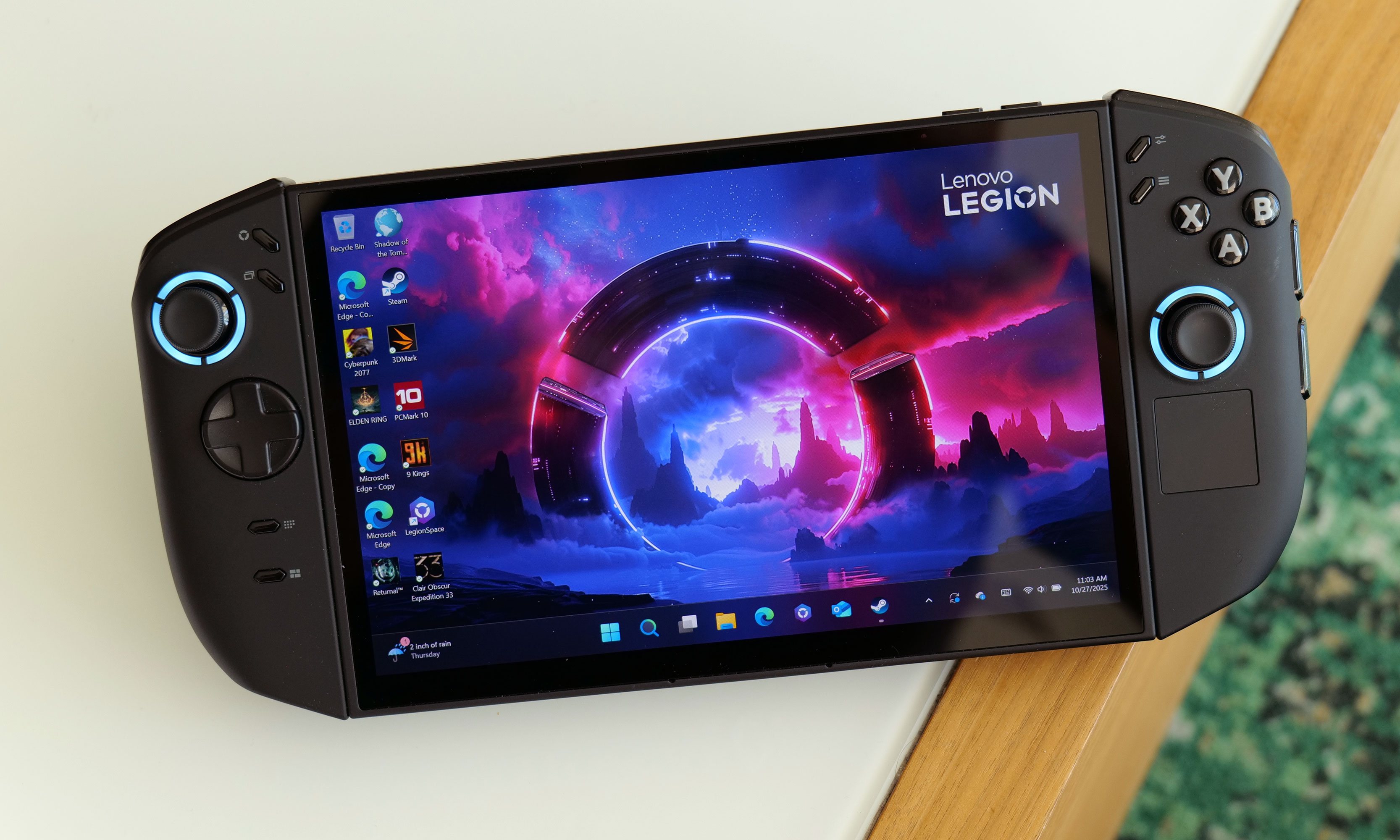
Lenovo Legion Go 2
The Lenovo Legion Go 2 is a capable alternative to the ROG Xbox Ally X with a mondo-sized 8.8-inch display. That screen is the main reason to consider it, as it’s a vivid OLED panel that supports VRR and has a 144Hz native refresh rate. Like the Switch, it also comes with detachable controllers — one of which includes a useful touchpad for navigating Windows — plus a built-in kickstand for tabletop play.
That said, it’s an absolute tank at just over two pounds, and we found it to perform a little worse than the Xbox Ally X at equal settings. It’s also even more expensive, starting at $1,100 and rising to $1,350 for a config with the same Ryzen Z2 Extreme chip. It’s a lovely device if you’ve got cash to burn — and to be fair, none of these Windows handhelds are for anyone looking for “value” — but the Xbox Ally X is a better buy for most.
MSI Claw 8 AI+
The original MSI Claw was a flop, but the newer Claw 8 AI+ is much more appealing if you’re willing to pay for a larger and slightly more powerful alternative to the ASUS ROG Ally X. With its Intel Core Ultra 7-258V chip and 32GB of RAM, it typically pumped out 10 to 15 percent higher frame rates than last-gen models like the ROG Ally X and Lenovo Legion Go in our testing. (Another model is available with the Ryzen Z2 Extreme chip.) Battery life is relatively strong, while its 8-inch 120Hz IPS display is plenty bright and supports VRR. There are smooth Hall effect thumbsticks and triggers, two Thunderbolt 4 ports and a built-in fingerprint sensor beyond that.
The Claw’s main issue is its price: At $1,100 after recent price hikes, it’s hard to justify over the ROG Xbox Ally X, which is already too expensive for most people. ASUS' handheld is lighter and easier to grip on top of that — though the Claw is thinner — and its overhauled Xbox UI, while far from perfect, is still easier to get around than MSI’s Center M hub. There's a smaller 7-inch version of this handheld for $900 as well, but we haven’t tested that one.
ModRetro Chromatic
The ModRetro Chromatic is a competitor to the Analogue Pocket that can similarly play actual Game Boy cartridges via FPGA. With its premium metal frame, loud speaker, tight d-pad and beautifully bright 2.56-inch display, it’s an impressive modernization of Nintendo’s classic handheld. ModRetro also publishes a number of games specifically for the device, including a pretty great version of Tetris that comes bundled in the box.
However, for many, its faithfulness to the original Game Boy probably goes too far: It requires three AA batteries for power, and unlike the Analogue Pocket it doesn’t support custom save states. It’s also designed for Game Boy and Game Boy Color games only; it can’t play any Game Boy Advance cartridges or games from other retro handhelds like Analogue’s device, nor does doesn’t support ROMs. For only $20 less than the Pocket, that makes it a tough sell, even if the hardware is arguably higher-quality.
There’s also the lethal, autonomous elephant in the room: ModRetro is founded by Palmer Luckey, the idiosyncratic entrepreneur behind the Oculus Rift who has gone on to form Anduril Industries, a defense contractor that makes drones, surveillance systems and other AI-powered military tech. He has also espoused political views that many people — and this is the tamest way I can put this — may not be comfortable backing. We are not here to police where you can spend your money, and the Chromatic does much of what it wants to do well. Still, all of these handhelds are just so inessential, and no other option that we know of is as closely tied to an arms dealer.
Lenovo Legion Go S (Windows, Z2 Go chip)
The Windows 11 version of the Lenovo Legion Go S has the same relatively comfortable design and commendable 8-inch 120Hz display as the SteamOS model we highlight above. With the Z2 Go model we tested, though, its performance lags too far behind the ROG Ally X, Claw 8 AI+ and original Legion Go for something priced at $730. Windows is still clunky, too.
Ayaneo Flip DS
The Ayaneo Flip DS is a cool concept: a powerful Windows machine with a clamshell design and dual displays, sort of like a supercharged Nintendo DS. It feels sturdy, it performs roughly on par with the other Ryzen 7 7840U (or 8840U) handhelds in this guide, and its 7-inch top display is sharp, fast and bright. The second screen makes it a natural fit for emulating Wii U or 3DS games, but you could also, say, look up a guide or play a YouTube video without having to close whatever you’re playing.
Unfortunately, this is more of a neat idea than a fully thought-out product. The folding design means that the joysticks have to be short and recessed, while the face buttons and d-pad are uncomfortably flat. The whole thing is overly thick and heavy, plus it runs very hot. Battery life tops out around two hours, and actually managing two displays on a Windows handheld is about as clunky as you'd expect. With prices now starting above $1,100, the Flip DS is hard to recommend unless you’re (oddly) desperate for a handheld Wii U emulator. We're always happy to see more weird hardware, though.
Ayaneo Kun
The Ayaneo Kun is one of the more decadent Windows handhelds we’ve tested. With a sharp 8.4-inch display, a Ryzen 7 8840U chip, up to 64GB of RAM, up to 4TB of storage, a sizable 75Whr battery and a 54W max TDP, it’s both a capable gaming device and a feasible replacement for a desktop PC. But it now starts at a pricey $999, it’s huge and it suffers from the usual Windows-related issues. It also lacks VRR, and that Ryzen chip is no longer the latest and greatest. The Kun is still a fine device in a vacuum, but the ROG Xbox Ally X is a better buy. This is technically an older model for Ayaneo, too, as the company seems to launch a new handheld every other hour these days.
Retroid Pocket Classic
The Retroid Pocket Classic is another Game Boy-style vertical handheld in the vein of the Analogue Pocket, but like the other Retroid models we’ve highlighted, it’s an Android device designed to emulate games via ROM files, not genuine cartridges. (Naturally, it can also play native Android games.) It’s still far clunkier to set up and use as a result, and its overall design feels more toy-like than either the Pocket or ModRetro Chromatic.
But its Snapdragon G1 Gen 2 chip is easily powerful enough to play any classic handheld system (along with most other retro games that don’t require joystick controls), while its 3.9-inch OLED display is superbly bright, sharp and colorful. The battery can last more than 10 hours when emulating lower-power systems, and Retroid sells a version with six face buttons instead of the standard four if you want to play older Sega Genesis and Saturn games in particular. The Analogue Pocket is still more premium and rewarding to use, but if you want a similar form factor and can live with the typical quirks that come with a device like this, the Classic is a good value at $129. Of the many Game Boy-style handhelds out there that solely rely on software emulation, it’s the one we’d recommend first.
Retroid Pocket Mini
The Retroid Pocket Mini is essentially a smaller version of the Retroid Pocket 5. It runs on the same Snapdragon 865 chip and feels just as sturdy, but it has a smaller 3.92-inch display with a 4:3 aspect ratio. This makes it a more natural fit for older retro consoles, as you won’t get the black boxes you’d see on a 16:9 display like the one on the Pocket 5. If you mainly want to emulate systems like the SNES, Sega Genesis or Game Boy Color and don’t mind paying extra for a rich OLED display, it’s a good little device. But the tiny screen is limiting if you ever want to play newer games, and we wish there wasn't so much empty space around the display.
This device had also generated some controversy within the retro gaming community for having persistent issues with inaccurate shaders (and for the slapdash way Retroid handled the matter). The company replaced the original model with a "V2" iteration that addresses those concerns, however.
Retroid Pocket 4 Pro and Retroid Pocket 4
The 4.7-inch Retroid Pocket 4 Pro is the predecessor to the Pocket 5. Its performance isn’t significantly far off the newer model, so it remains a nice value if you’re determined to spend less than $200 on an emulation device. It misses out on the larger OLED display and more ergonomically-friendly design of its follow-up, however. The base Pocket 4 may also be worth a look if you want to stay under $150, but its weaker chip makes it less adept at emulating games from the PS2, GameCube and up.
Miyoo Mini Plus
The Miyoo Mini Plus is a highly affordable handheld with a well-built, Game Boy-style form factor that fits nicely with older games. Its 3.5-inch display pops for something in the $60 to $80 range, its battery lasts as long as it needs to and it can emulate consoles up to the original PlayStation without much issue. Its Linux-based software is extensively customizable, though it requires some tinkering to get it working optimally. Like many cheapo handhelds, it also lacks fast charging. Since it’s from a smaller Chinese firm and isn’t available at major retailers, it can also be difficult to actually buy. It's a nice choice if you want something more compact than the Retroid Pocket Classic, but that model's roomier design, more vibrant OLED panel and longer battery life makes it worth the extra cash for most people.
TrimUI Brick
The TrimUI Brick is another low-cost vertical handheld that’s surprisingly well-built for an $80-ish device, thanks to its brushed metal backplate and impressive 3.2-inch IPS display. It has a weaker chip than the Retroid Pocket Classic, but it can still emulate older handheld games just fine, and its tiny frame makes it much easier to actually fit in a pocket. That said, while it has a sharper and more vivid screen than the Miyoo Mini Plus (its closest rival), the face buttons, d-pad and especially back buttons are all stiffer, and its stock UI feels similarly bootleg. (Some of the icons for different systems in the game library: “GomeBuy,” “Fanicon,” and “PloyStotion.”) You can fix the latter with custom firmware, but Retroid’s interface is easier to grok by default, and its setup process is less annoying. Most people interested in this class of device will be happier paying up for the Pocket Classic instead.
Anbernic RG35XX Plus
The Anbernic RG35XX Plus is another wallet-friendly vertical handheld. For about the same price as the Miyoo Mini Plus, it offers a faster chipset, more RAM and a bigger battery alongside a similarly impressive design. Its stock OS is overly sloppy and cheap-looking, however, and while its stronger chip is appreciated, it's still far behind the Retroid Pocket Classic.
Anbernic RG35XXSP
The Anbernic RG35XXSP is a variant of the RG35XX Plus based on the same internals, only it apes the clamshell form factor of the old Game Boy Advance SP. That’s a great design to rip off if you must pick one, and the hardware doesn’t feel nearly as cheap as its (pre-tariff) price tag of $60 or so would suggest. But the software issues noted above still apply (both here and with the many other devices in the same RGXX family). We’ve also seen several user reports of quality control issues with the RG35XXSP’s battery, which is automatically disqualifying.
Anbernic RG405M
The Anbernic RG405M is another 4:3 handheld with a 4-inch display and a pleasing metal frame. It's an OK alternative to the Retroid Pocket Mini if you want a little more screen space for less cash, but it’s slower, and it lacks the Mini’s OLED display. We find the Retroid’s grooved back to be comfier to hold over time as well. And again, Anbernic has paused handheld shipments to America as of this writing.
PlayStation Portal
The PlayStation Portal is an odd accessory that’s designed to stream games from a PlayStation 5. It lacks built-in apps, so it doesn’t support traditional emulation. Because it’s entirely dependent on the quality of your home Wi-Fi, we can’t guarantee how well it’ll actually perform. It doesn’t work with Bluetooth earbuds either.
The 8-inch display is fine and the DualSense-style controls are great, so PlayStation diehards who want a second screen for local PS5 streaming may see the appeal. Sony recently added the ability to stream a selection of games via the cloud, which is a step in the right direction, but you need an expensive PlayStation Plus Premium subscription to take advantage. In general, there’s little here that you can’t do with a smartphone and mobile game controller, so most people are better off saving their $200.
Logitech G Cloud
The Logitech G Cloud would’ve been a great Android pick when it launched if it cost about $150 less. Its 7-inch 1080p display is bright, vibrant and generally more pleasing to look at than the panel on the AYN Odin 2, its battery lasts a good 10 to 12 hours per charge and its design is comfy to hold for hours at a time. Alas, the G Cloud still tends to retail for $300, which is just too much when the Retroid Pocket 5 offers more power at a lower price.
What to know about the gaming handheld market
You can break down the gaming handheld market into three broad tiers. At the top, you have x86-based portable gaming PCs like the Steam Deck or ASUS ROG Xbox Ally X. These are the most powerful handhelds you can buy, as they seek to replicate the experience of a moderately specced gaming desktop. The Steam Deck runs on Linux, but most others use Windows. If you want to play modern, recently released PC games on the go (and need something stronger than a Switch), this is the type of device you’d get. They can also emulate the widest range of retro consoles. They’re typically the largest and most cumbersome devices to hold, however, and their battery life can be short. Naturally, they’re also the most expensive, costing anywhere from $400 to more than $1,000.
Further down on the price spectrum are "mobile handhelds" like the Logitech G Cloud or Retroid Pocket. These devices often run Android or Linux and can range from under $50 to $400-ish (before tariffs). They aren’t equipped to play modern console or PC titles, but they’re usually more compact than a portable PC, and you can still use them for mobile games and cloud streaming. While most are marketed toward those ends, many gamers actually buy them to emulate classic games through software like RetroArch. Getting emulators to work can be complicated, and accessing the BIOS and ROM files required to play games this way is legally murky. One lawsuit from Nintendo led to the shutdown of the most prominent Switch and 3DS emulators, for instance. (Engadget does not condone piracy.) Backing up files of games you already own for personal use only is considered more defensible, though, so for that a mobile handheld can be a more user- and wallet-friendly way to play the classics — provided you don’t want to just use your phone.
We’ll call the last tier “handhelds that do their own thing.” This is a catch-all for things like the Switch 2 or Playdate: portable devices that run heavily customized software and aim to provide a unique gaming experience. They aren’t necessarily ideal for emulation or playing the latest multiplatform titles; instead, they often have distinct game libraries. They might not have the widest appeal as a result (Switch excluded), but they’re often easier for less tech-literate folks to just pick up and use.
Recent updates
November 2025: The ASUS ROG Xbox Ally X replaces the older ROG Ally X as our new favorite Windows gaming handheld. We’ve also added testing notes on the Lenovo Legion Go 2, ModRetro Chromatic and a couple of emulation-based handhelds in the Retroid Pocket Classic and TrimUI Brick. We’re working to test several other recent releases for our next update, including updated versions of the Retroid Pocket 5 and AYN Odin 2.
August 2025: We’ve added the SteamOS version of the Lenovo Legion Go S as a new recommendation and updated our top Windows pick to reflect the upcoming release of ASUS’ and Microsoft’s ROG Xbox Ally devices, which will feature an overhauled Windows UI. We’ve also added a note on the recently released Nintendo Switch 2. We’ll include testing notes on the Retroid Pocket Classic, TrimUI Brick and ModRetro Chromatic in the near future. (Note: Yours truly went on paternity leave after our last update — apologies for the delay!)
May 2025: We’ve tested the Retroid Pocket Flip 2 and recommended it as an alternative to the Retroid Pocket 5. We’re also watching out for the first third-party devices that run SteamOS, starting with the new Lenovo Legion Go S, and the next ASUS ROG Ally device, which seems to be arriving soon based on recent leaks.
March 2025: We’ve edited this guide for clarity and added testing notes for the MSI Claw 8 AI+ and Lenovo Legion Go S (Windows version). Our main picks are unchanged. Looking ahead, we’re keeping an eye on upcoming Windows handhelds from Acer and Ayaneo, a pair of new emulation devices from Retroid, the first third-party devices to ship with SteamOS and more machines that run on AMD’s Ryzen Z2 chips, among others.
January 2025: We have a new top pick among emulation-focused handhelds: the Retroid Pocket 5. Beyond that, we’ve added notes on a few other devices we’ve tested, including the Retroid Pocket Mini and Anbernic RG35XXSP; lightly edited other blurbs to reflect changes in the market; and removed a couple write-ups for products that’ve been discontinued. We're also keeping an eye on new handhelds that’ve recently been announced or are strongly rumored to arrive in the near future, including devices from MSI and Lenovo.
August 2024: We’ve replaced the ASUS ROG Ally, our prior pick for the best Windows gaming handheld, with the new and improved ROG Ally X. We’ve also checked to make sure all availability and pricing details noted throughout the guide are accurate.
June 2024: We’ve updated this guide to ensure all of our recommendations are up to date, adding a note on ASUS’ upcoming ROG Ally X in the process. We’ve also included details on two new handhelds we’ve tested since our previous update: the MSI Claw and Ayaneo Flip DS. Staying on top of this market is a tall task, but we’re currently looking at recent noteworthy releases like the PSP-esque AYN Odin 2 Mini and the GBA-style Anbernic RG35XXSP as well.
This article originally appeared on Engadget at https://www.engadget.com/gaming/best-handheld-gaming-system-140018863.html?src=rss
OpenAI has hired the developer behind AI agent OpenClaw
16 Feb 2026, 9:29 am by Steve Dent
Recently we were introduced to OpenClaw, an AI that allows users to create their own agents to control apps like email, Spotify and home controls. Now, Sam Altman has announced that OpenAI has absorbed OpenClaw by hiring developer Peter Steinberger "to drive the next generation of personal agents," he wrote on X. Steinberger confirmed the news on his own blog. "I’m joining OpenAI to work on bringing agents to everyone. OpenClaw will move to a foundation and stay open and independent."
Steinberger was also in talks to join Meta, with both companies reportedly making offers in the "billions," according to Implicator.AI. The primary attractant was said to be OpenClaw's 196,000 GitHub stars and 2 million weekly visitors rather than its codebase.
OpenClaw became buzzy in the last few weeks thanks to its multifaceted ability to carry out tasks. People have used it to create agents that can write code, clear their inboxes, do online shopping and other assistant-like jobs. On its website, OpenClaw touts its ability to interact with popular apps and sites including WhatsApp, Discord, Slack, iMesage, Hue and Spotify.
Peter Steinberger is joining OpenAI to drive the next generation of personal agents. He is a genius with a lot of amazing ideas about the future of very smart agents interacting with each other to do very useful things for people. We expect this will quickly become core to our…
— Sam Altman (@sama) February 15, 2026
OpenClaw was recently called "Clawdbot" but Anthropic forced a name change due to similarities with its "Claude" branding. OpenClaw is often compared to Claude Code by "vibe coders" seeking to automate website development and other programming chores.
In his announcement, Altman said that "the future is going to be extremely multi-agent and it's important to support open source as part of that," adding that "OpenClaw will live in a foundation as an open source project" supported by Open AI. Steinberger, meanwhile, said that "what I want is to change the world, not build a larger company and teaming up with OpenAI is the fastest way to bring this to everyone."
This article originally appeared on Engadget at https://www.engadget.com/ai/openai-has-hired-the-developer-behind-ai-agent-openclaw-092934041.html?src=rss
The best cheap phones for 2026
16 Feb 2026, 8:00 am by Igor Bonifacic,Sam Rutherford
A few years ago, it may have been fashionable to spend $1,000 on the latest flagship smartphone, but for most people, that’s neither practical nor necessary. You don't even have to spend $500 today to get a decent handset, whether it’s a refurbished iPhone or an affordable Android phone, as there are plenty of decent options as low as $160.
However, navigating the budget phone market can be tricky; options that look good on paper may not be in practice, and some devices will end up costing you more when you consider many come with restrictive storage. While we spend most of our time reviewing mid- to high-end handsets at Engadget, we've tested a number of the latest budget-friendly phones on the market to see cut it as the best cheap phones you can get right now.
Best cheap phones
What to look for in a cheap phone
For this guide, our top picks cost between $100 and $300. Anything less and you might as well go buy a dumb phone instead. Since they’re meant to be more affordable than flagship phones and even midrange handsets, budget smartphones involve compromises; the cheaper a device, the lower your expectations around specs, performance and experience should be. For that reason, the best advice I can give is to spend as much as you can afford. In this price range, even $50 or $100 more can get you a dramatically better product.
Second, you should know what you want most from a phone. When buying a budget smartphone, you may need to sacrifice a decent main camera for long battery life, or trade a high-resolution display for a faster CPU. That’s just what comes with the territory, but knowing your priorities will make it easier to find the right phone.
It’s also worth noting some features can be hard to find on cheaper handsets. For instance, you won’t need to search far for a device with all-day battery life — but if you want a phone with excellent camera quality, you’re better off shelling out for one of the recommendations in our midrange smartphone guide, which all come in at $600 or less.
Wireless charging and waterproofing also aren’t easy to find in this price range and forget about the fastest chipset. On the bright side, most of our recommendations come with headphone jacks, so you won’t need to buy wireless headphones.
iOS is also off the table, since, following the discontinuation of the iPhone SE, the $599 iPhone 16e is now the most affordable offering from Apple. That leaves Android as the only option in the under-$300 price range. Thankfully today, there’s little to complain about Google’s operating system – and you may even prefer it to iOS.
Lastly, keep in mind most Android manufacturers typically offer far less robust software features and support for their budget devices. In some cases, your new phone may only receive one major software update and a year or two of security patches beyond that. That applies to the OnePlus and Motorola recommendations on our list.
If you’d like to keep your phone for as long as possible, Samsung has the best software policy of any Android manufacturer in the budget space, offering at least four years of security updates on all of its devices. Recently, it even began offering six years of support on the $200 A16 5G, which we recommend below. That said, if software support (or device longevity overall) is your main focus, consider spending a bit more on the $500 Google Pixel 9a, or even the previous-gen Pixel 8a, which has planned software updates through mid-2031.
This article originally appeared on Engadget at https://www.engadget.com/mobile/smartphones/best-cheap-phones-130017793.html?src=rss
End of today’s Engadget roundup.