This digest compiles the latest from Engadget.
Today’s Engadget Roundup
EU says Pornhub and others failed to stop minors accessing adult content
26 Mar 2026, 3:56 pm by Kris Holt
The European Commission (EC) accused four porn platforms of not doing enough to prevent minors from accessing their content. In its preliminary findings of a 10-month investigation, the European Union's regulatory arm said Pornhub, Stripchat, XNXX and XVideos have breached the Digital Services Act (DSA).
The EC said the platforms have an ineffective “self-declaration“ measure — they only require users to make a single click to state they are over 18. Nor do efforts like content warnings, page blurring and "restricted to adults" labels "effectively prevent minors from accessing harmful content." As such, the EC said the platforms are failing to protect the wellbeing and rights of minors, and it demanded that they put privacy-preserving age verification systems in place.
Furthermore, the EC said the quartet did not use objective and thorough methodologies to fully assess the risks to minors accessing content on their platforms. The regulator determined Stripchat, Xvideos and XNXX either misrepresented or failed to take into account consultations with organizations that specialize in children's rights and age verification systems in their risk assessments. It also suggested that the platforms' risk assessments "disproportionately emphasized business-centric concerns, such as reputational damage, rather than focusing on the societal risks to minors."
The platforms now have the chance to review the EC's preliminary findings and respond to them. They can implement measures to remedy the alleged DSA breaches as well. However, if the Commission confirms that the platforms failed to adhere to the DSA and it decides to issue a non-compliance decision, the porn providers could be on the hook for fines of up to six percent of their global annual turnover.
“In the EU, online platforms have a responsibility. Children are accessing adult content at increasingly younger ages and these platforms must put in place robust, privacy-preserving and effective measures to keep minors off their services,” Henna Virkkunen, the European Union’s executive vice-president for tech sovereignty, security and democracy, said in a statement. “Today, we are taking another action to enforce the DSA — ensuring that children are properly protected online, as they have the right to be.”
This article originally appeared on Engadget at https://www.engadget.com/big-tech/eu-says-pornhub-and-others-failed-to-stop-minors-accessing-adult-content-155632108.html?src=rss
AMD's Ryzen 9950X3D2 chip features an incredible 208MB of on-chip cache
26 Mar 2026, 3:41 pm by Lawrence Bonk
AMD just revealed the Ryzen 9950X3D2 Dual Edition desktop processor, which is a beastly follow-up to last year’s 9950X3D. This is the company’s first desktop processor where both chiplets have been equipped with AMD’s proprietary 3D V-Cache technology, which seems like a boon for gamers. Each chiplet includes 104MB of cache, offering an incredible 208MB total on-chip cache.
“208MB of cache means more game data, more assets and more working data sitting right next to the CPU cores,” AMD Senior VP Jack Huynh explained in an announcement video.
Just like last year’s release, the 9950X3D2 features a 16-core processor based on the Zen 5 architecture. This new release has increased to a 200W TDP, compared to the 170TDP of the original. This could indicate an increase in speed and performance, but with more heat output.
AMD says the chip will be great for both gaming and for creative workloads, like compiling game engines, running AI models and rendering 3D objects. The company says it can deliver a five to 10 percent performance boost when using applications like Unreal Engine, Chromium, Blender and DaVinci Resolve.
Last year’s 9950X3D chip was already an absolute powerhouse, so we are looking forward to putting this one through its paces. The Ryzen 9950X3D2 chip will be available on April 22, though we don’t have a price just yet. The standard 9950X3D currently costs around $675.
This article originally appeared on Engadget at https://www.engadget.com/computing/amds-ryzen-9950x3d2-chip-features-an-incredible-208mb-of-on-chip-cache-154137156.html?src=rss
How to use Apple's Playlist Playground to make AI-generated mixes
26 Mar 2026, 1:45 pm by Igor Bonifacic
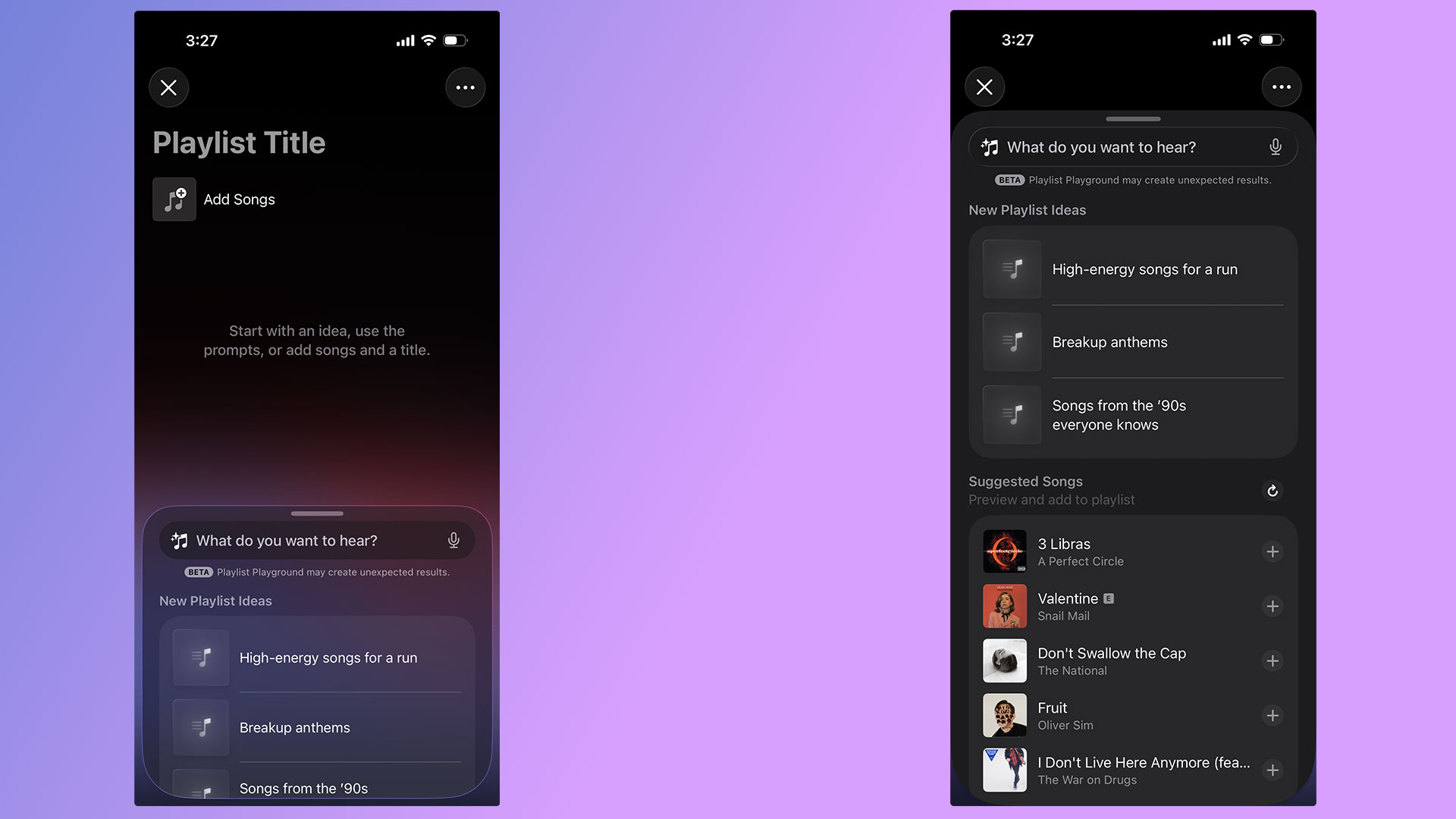
With the release of iOS 26.4, Apple Music's Playlist Playground can now generate playlists with the help of AI. Best of all, you don't need an Apple Intelligence-capable iPhone to take advantage of the new feature. As long as you're a US Apple Music subscriber with your language set to English, you can start using Playlist Playground right now. Here's how to get started.
How to create playlists using Playlist Playground
For the time being, there are two ways to access Playlist Playground. For the time being, the company is highlighting the feature within the "Top Picks for You" section of Apple Music's Home tab. If you don't see a shortcut there, Apple integrated the feature into the app's existing playlist creation tool. Just tap the new icon found in the Library tab. If you're new to Apple Music, the flow looks like this:
-
Open Apple Music.
-
Navigate to the "Library" tab.
-
Tap the playlist creation button.
-
Write a prompt describing the mood or style of music you want to hear.
To help people get started, Apple provides a selection of sample prompts. One pro tip: it's possible to use metadata in conjunction with Playlist Playground. For example, after Apple Music generates a playlist, you can tell Apple's model to edit it by removing any songs released before 2016. Of course, you're also free to add and remove songs manually as you please.
Once you're happy with your new playlist, Apple Music treats all Playlist Playground mixes like it does any other playlist, meaning you can save it to your Library, download for offline playback, play it from your Apple Watch and share it with friends and invite them to add songs.
FAQ
What Apple devices is Playlist Playground available on?
As of the writing of this article, Playlist Playground is a beta release only available to Apple Music subscribers in the US with their preferred language set to English. An iPhone or iPad running iOS 26.4, or an Apple Vision headset running visionOS 26.4 is also required.
As Apple releases the feature in more countries and languages, we'll update this article.
Is Playlist Playground available on Android?
Yes, if you use Apple Music on Android, Playlist Playground is available there too.
How does Playlist Playground work?
When generating mixes, Playlist Playground pulls from both trending data and your personal listening history. Along with other AI-powered Apple Music features like AutoMix and Lyrics Translation, Playlist Playground runs as part of the Apple Music service. That’s one of the reasons Apple can offer it outside of Apple Intelligence-capable devices.
This article originally appeared on Engadget at https://www.engadget.com/entertainment/music/how-to-use-apples-playlist-playground-to-make-ai-generated-mixes-134500610.html?src=rss
HBO Max finally launches in the UK and Ireland
26 Mar 2026, 1:34 pm by Matt Tate
It’s been a long wait, but HBO Max has finally arrived in the UK and Ireland, rounding off the streaming service’s European expansion. Oscar-winners One Battle After Another and Sinners are both available to stream at launch, alongside Max Original shows like The Pitt. Season three of Euphoria arrives in April, and HBO Max is also home to mega-franchises like The Lord of the Rings and Harry Potter, both of which are celebrating their 25th anniversaries in 2026.
Starting today, March 26, UK audiences can choose from three plans. Basic with Ads costs £5 per month, and offers all HBO shows and select Warner Bros. movies at 1080p, with movies that first stream on HBO Max after their theatrical release excluded. Then there's Standard with Ads for £6 per month, which includes those straight-from-theaters releases and 30 downloads at the same resolution. Both can stream on two devices at a time.
For an ad-free experience you can purchase a Standard or Premium plan. The former has all titles available on two devices, up to 30 downloads and, obviously no ads. Finally, the most expensive £15 per month Premium plan allows streaming on four devices in up to 4K Ultra HD with Dolby Atmos. You also get 100 offline downloads on this tier.
Eligible Sky TV customers will automatically have HBO Basic with Ads rolled into their packages at no extra cost, thanks to an expanded partnership between Sky and Warner Bros. Discovery. This extends to NOW Entertainment subscribers, who will find HBO Max integrated into the NOW app. HBO Max is also now home to TNT Sports in the UK, which streams over 50 matches in the Premier League, as well as being home to the UEFA Champions League and various other sporting competitions, including MotoGP and the Tour de France.
HBO Max launches in the UK as Warner Bros Discovery sets a date for the shareholder vote on its merger with Paramount Skydance, which was finally agreed last month. Netflix was paid a $2.8 billion fee for breaking up its initial well-documented deal to buy the historic studio.
This article originally appeared on Engadget at https://www.engadget.com/entertainment/streaming/hbo-max-finally-launches-in-the-uk-and-ireland-133406342.html?src=rss
WhatsApp rolls out updates including multiple accounts for iOS
26 Mar 2026, 1:00 pm by Anna Washenko
WhatsApp shared multiple quality of life updates coming to its messaging platform starting today. The first is a long awaited option to have two accounts on a single iOS device. The option has been available for years on Android, and iPhone users can now be logged into two separate accounts at once. The profile photo for the account will be visible in the bottom tab to double-check which persona you're messaging as.
The other new features allow for easier movement of chat histories, both between platforms and devices in the same ecosystem. This chat transfer should make it easier to retain messages when upgrading to a new phone, especially if you're switching between iOS and Android. There's also a new option to delete large files directly from a WhatsApp chat to avoid storage clutter. It's available under the Manage Storage option when you tap a chat's name. It includes an option to delete just media files from a conversation.
And of course it wouldn't be a tech news announcement without at least some AI features present. WhatsApp now supports using Meta AI for light photo editing, including removing backgrounds, changing aesthetic styles and deleting elements from the composition. There's also a Writing Help prompt that uses AI to help draft a message, although Meta's blog post states that using this still keeps chats private. The above features should be arriving to all WhatsApp users “soon,” according to the company.
This article originally appeared on Engadget at https://www.engadget.com/social-media/whatsapp-rolls-out-updates-including-multiple-accounts-for-ios-130000252.html?src=rss
March Madness 2026: How to watch the Sweet 16 and Elite Eight this weekend
26 Mar 2026, 1:00 pm by Billy Steele
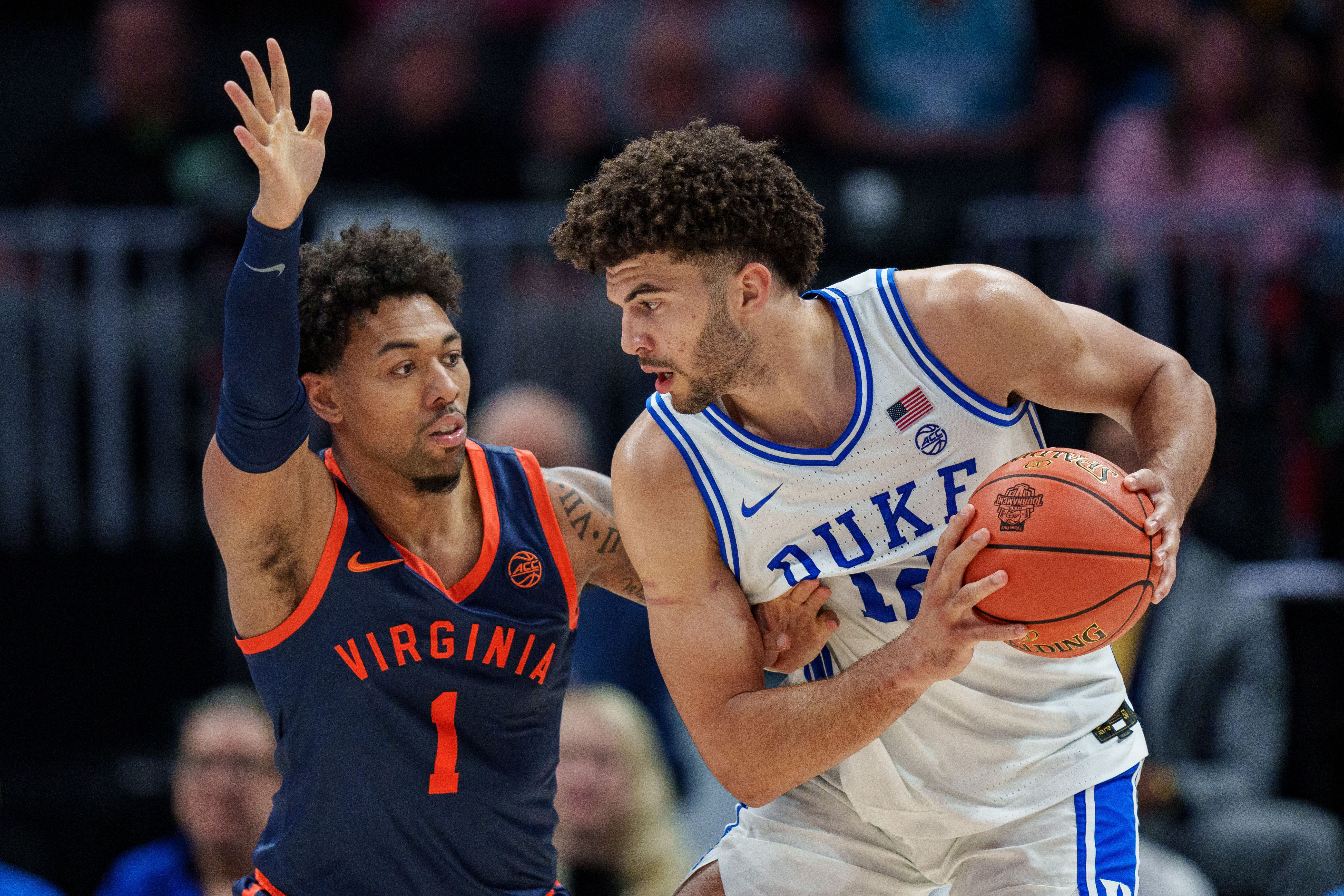
It’s time to lock in those brackets. The 2026 NCAA basketball tournaments, affectionately known as March Madness, begin this week. In fact, some of the action on the men’s side starts tonight. Both the men’s and women’s tournaments are available to stream through various apps and services, but navigating the web of broadcasters and TV channels can be confusing. We’ve broken down when all the games are happening, where to watch and the best options for saving some cash doing so.
What does the Sweet 16 and Elite Eight start?
The men’s NCAA Basketball Tournament Sweet 16 begins on Thursday, March 26 with four of the eight games. The first game begins at 7:10PM ET with the others following at 7:30PM ET, 9:45PM ET and 10:05PM ET. A similar schedule is expected for the second slate of Sweet 16 games on Friday, March 27. The Elite Eight will then follow on Saturday, March 28 and Sunday, March 29 with two games each day. Start times haven’t been announced for those just yet.
On the women’s side, everything is offset by a day. The first four Sweet 16 games take place on Friday, March 27 at 2:30PM ET, 5:00PM ET, 7:30PM ET and 10:00PM ET. The second set of matchups follows on Saturday, March 28 at 12:30PM ET, 3:00PM ET, 5:00PM ET and 7:30PM ET. The Elite Eight matchups are on Sunday, March 29 and Monday, March 30 with two games each day, but start times haven’t been announced for those.
Here’s the full schedule for each tournament:
2026 Men’s NCAA Basketball Tournament
-
First Four: March 17-18
-
First round: March 19-20
-
Second round: March 21-22
-
Sweet 16: March 26-27
-
Elite Eight: March 28-29
-
Final Four: April 4
-
Championship game: April 6
2026 Women’s NCAA Basketball Tournament
-
First Four: March 18-19
-
First round: March 20-21
-
Second round: March 22-23
-
Sweet 16: March 27-28
-
Elite Eight: March 29-30
-
Final Four: April 3
-
Championship game: April 5
How to stream the 2026 Men’s NCAA Tournament
CBS and Warner Bros. Discovery share the broadcast rights to the men’s tournament, so TV coverage will be spread across four networks. During the course of March Madness, games will air on CBS, TNT, TBS and truTV, with the final rounds and championship game landing on TBS.
If you already have a paid TV plan (such as traditional cable), a good way to watch the men’s tournament is with the March Madness Live app or website. There’s a big catch though: CBS games aren’t available in the app. That means this is really only a good option through the Elite Eight. Once you log in with your TV provider credentials, you can watch games on the other networks in one spot with features like multiview (up to four games at once) and a Fast Break stream that covers all the in-progress games in one spot.
The app also offers ways to follow your bracket, if you filled it out on MarchMadness.com. And when you’re watching on desktop, the crucial Boss Button will throw up a fake work screen to keep your job safe. In addition to your laptop or phone, March Madness Live is also available on Amazon devices, Fire TV, Apple TV, iOS, macOS, Google Play, LG smart TVs, Roku and Xbox consoles.
The most affordable option to watch every game is to actually use two services. It’s not ideal, I know, but it will save you a lot of money. HBO Max’s Basic plan is $11/month and gives you access to live games from TNT, TBS and truTV with three-game multiview (46 games total). That includes the Final Four and National Championship as those three games are on TBS this year. If you splurge for a pricier plan ($23/month), you can stream games in Dolby Vision with Dolby Atmos surround sound. For the CBS games, you’ll need a Paramount+ Premium subscription that costs $14/month ($6 for two months for new users). So, with this best price scenario, streaming all of the men’s tournaments will cost $25 across two apps.
A live TV service like YouTube TV or Hulu + Live TV is over $80 more per month at full price, but they would offer you all the games in the men’s tournament in one place. YouTube TV is currently on sale for $60/month for the first two months after a free 10-day trial. Hulu + Live TV now includes Disney+ and ESPN Select, hence its higher price.
How to stream the 2026 Women’s NCAA Tournament

While Warner Brothers Discovery owns the rights to the men’s NCAA Tournament, ESPN has the women’s bracket locked down. Every game of the women’s tournament will be spread across ABC, ESPN, ESPN2, ESPNU and ESPNEWS, including the First Four matchups. The Final Four will be on ESPN, but the championship game will air on ABC. All three of those culminating games will stream on ESPN+ (and in the ESPN app) as MegaCast feeds.
ESPN says the MegaCasts are available in two options. First, Beyond the Rim provides an aerial camera angle with the main commentary and replays, plus the addition of enhanced stats. On the Rail shows you game action the full length of the floor. This feed will offer “natural” sound and replays.
Since ESPN+ won’t get every game, it’s not an option if you want to watch the entire tournament. However, since last year’s March Madness, Disney debuted standalone offerings for ESPN. The most affordable option here is ESPN Select which includes women’s college basketball and costs $13/month.
You could also opt for a live-TV streaming service like Sling, YouTube TV or Hulu + Live TV for a comprehensive experience. Sling is the cheapest of these, with the requisite Orange and Sports Extra plan costing $57 (Sling is currently offering a discount on the first month of Orange). YouTube and Hulu live TV options are both more expensive at over $80/month (YouTube TV currently discounted to $60 for the first two months), so it’s a matter of which set of content and features you like best. YouTube TV offers a handy multiview tool so you can watch up to four games at once, but Hulu + Live TV comes with Disney+ and ESPN Select for that cost.
Once you have a TV plan that includes the ESPN family of networks, the ESPN app is the best place to watch the tournament. The mix of scores and info, along with multiview streaming for up to four games at a time on Apple TV and Xbox, make the app a well-equipped conduit for the women’s tournament.
The March Madness website only shows scores and news for the women’s tournament. None of the women’s games will be available for streaming live on the website.
Are any of the March Madness games available to stream for free?
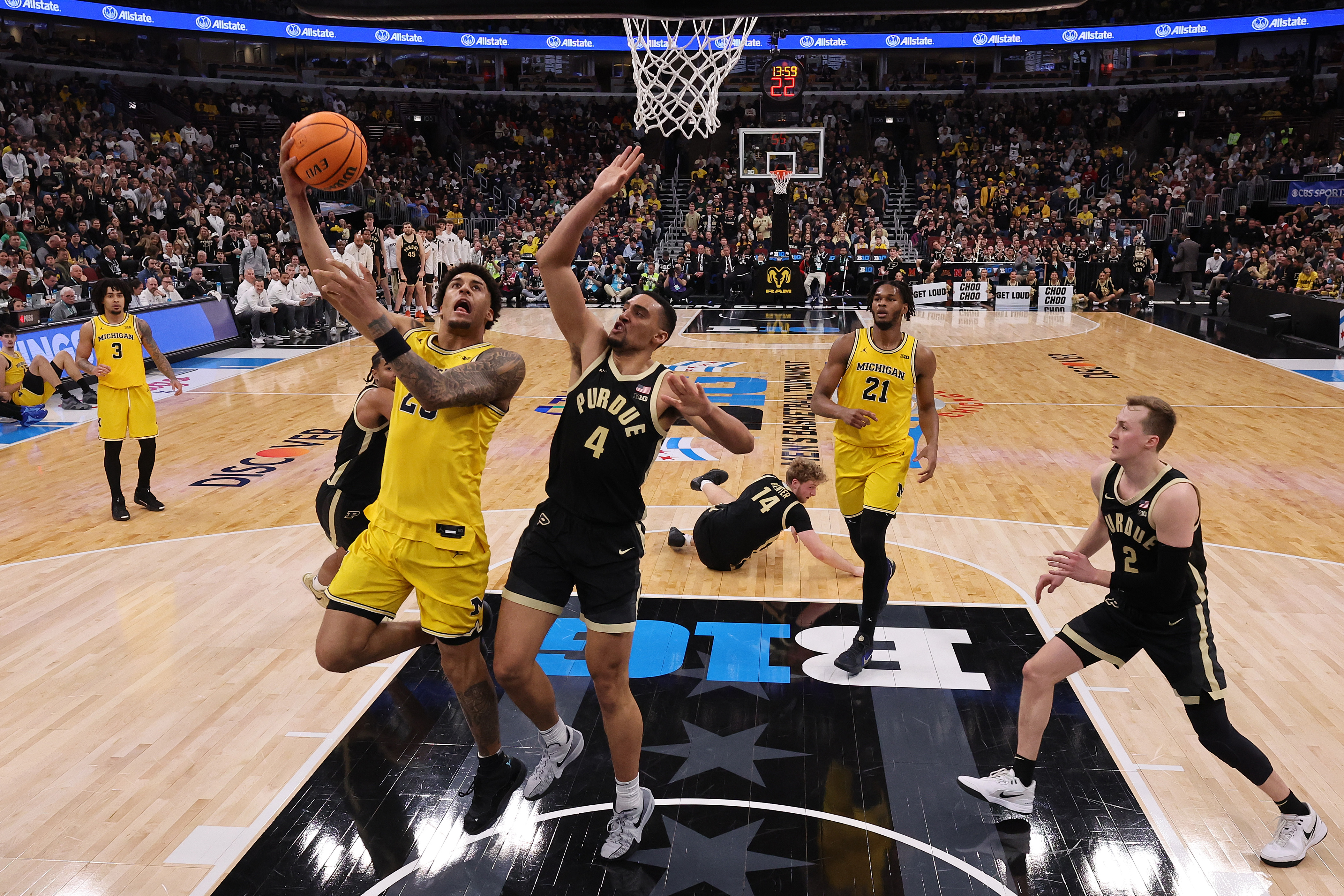
Without a TV provider login, you can watch all of the games broadcast on CBS on the March Madness website and mobile apps. Sure, it’s a small sample of the tournament, but it’s completely free and a good option for casual fans who don’t have a paid TV plan they can exploit for more of the action. It’s also a good way to watch the first round at work, if your company hasn’t blocked streaming sites, or if you can discreetly watch on your phone.
For the women’s tournament, there aren’t any games available for free. Unless you have an old-school OTA antenna, that is, in which case you can watch women’s games on ABC (and men’s games on CBS) without any kind of streaming plan. Of course, as this is a streaming guide published in 2026, I’d consider an antenna an extraordinary move.
If you were hoping to use a free trial period to watch March Madness, I’ve got bad news. None of them will last long enough to cover the entire tournament. Some services don’t offer a free trial at all, but the longest is YouTube TV at 10 days. Sadly, that won’t even get you through the second weekend.
What if I want to stream both the men’s and women’s tournaments?
If you’re hoping to stream all of the men’s and women’s NCAA tournaments, I hope you ordered Samsung’s eight-TV bundle. In terms of streaming services, just jump straight to a live-TV option like YouTube TV or Hulu + Live TV. I prefer the former because of its multiview feature. At times when there are multiple games that you want to watch, especially during the first two rounds, you’ll want multiview in order to keep tabs on all of the action.
This article originally appeared on Engadget at https://www.engadget.com/entertainment/streaming/march-madness-2026-how-to-watch-the-sweet-16-and-elite-eight-this-weekend-154903032.html?src=rss
Sonos Play review: The company's best portable speaker so far
26 Mar 2026, 1:00 pm by Nathan Ingraham
It’s been a rough couple of years for Sonos. In mid-2024, the company released a redesigned and thoroughly busted update to its app, which Sonos owners need to set up new products, manage their speaker groups, play music and access a host of other crucial features. The fallout from that was far-reaching — the company replaced its CEO, canceled a few planned products and released no new hardware in 2025.
The Sonos Play, announced earlier this month, is the company’s reset button, a way to remind people what the company does well. The Play is a portable speaker that sits between the $499 Sonos Move 2 (which is large, expensive and extremely loud) and the $179 Roam 2 (the cheapest Sonos speaker and tiny enough to bring anywhere). The $299 Play sits right in the middle of the company’s portable lineup in both size and price — and after spending a few weeks listening to it, I think it’s a very smart addition to the collection. Thanks to its impressive sound quality, versatility and portability, the Play is immediately one of the best speakers Sonos sells. The timing couldn’t be better, either, with warmer weather finally on the way.
Feature set
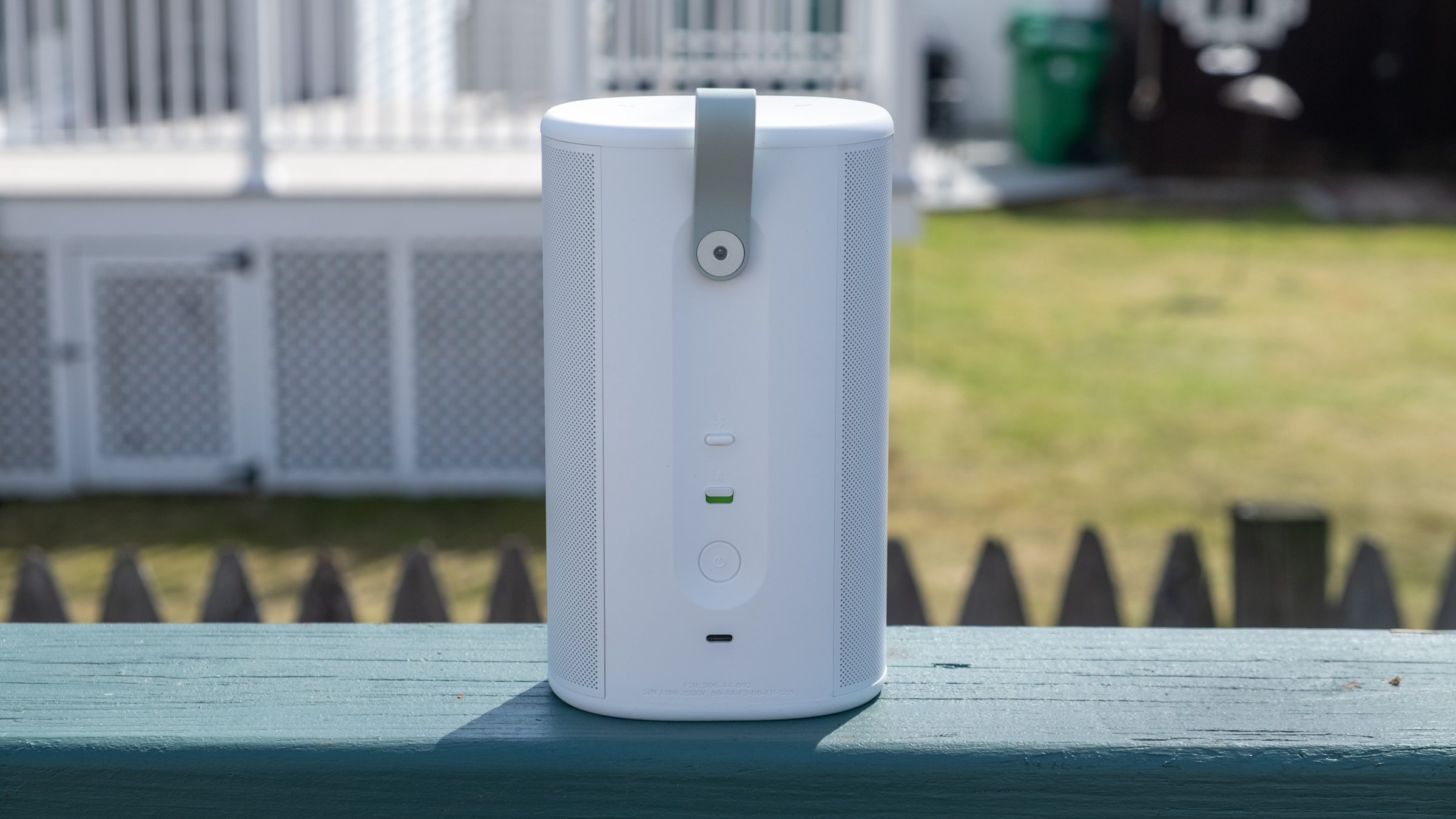
Like all other Sonos speakers, the Play is a Wi-Fi smart speaker that can stream audio from dozens of services; you can also play content on it via AirPlay 2, Spotify Connect and Bluetooth. The USB-C port on the back also lets you connect to turntables, CD players and other audio devices via a line-in dongle, or you can also use that port for an Ethernet connection (again with the corresponding dongle). Finally, you can also control the Play via Amazon Alexa or the Sonos Voice Assistant. And like the Roam, the Play is IP67 rated for water and dust resistance.
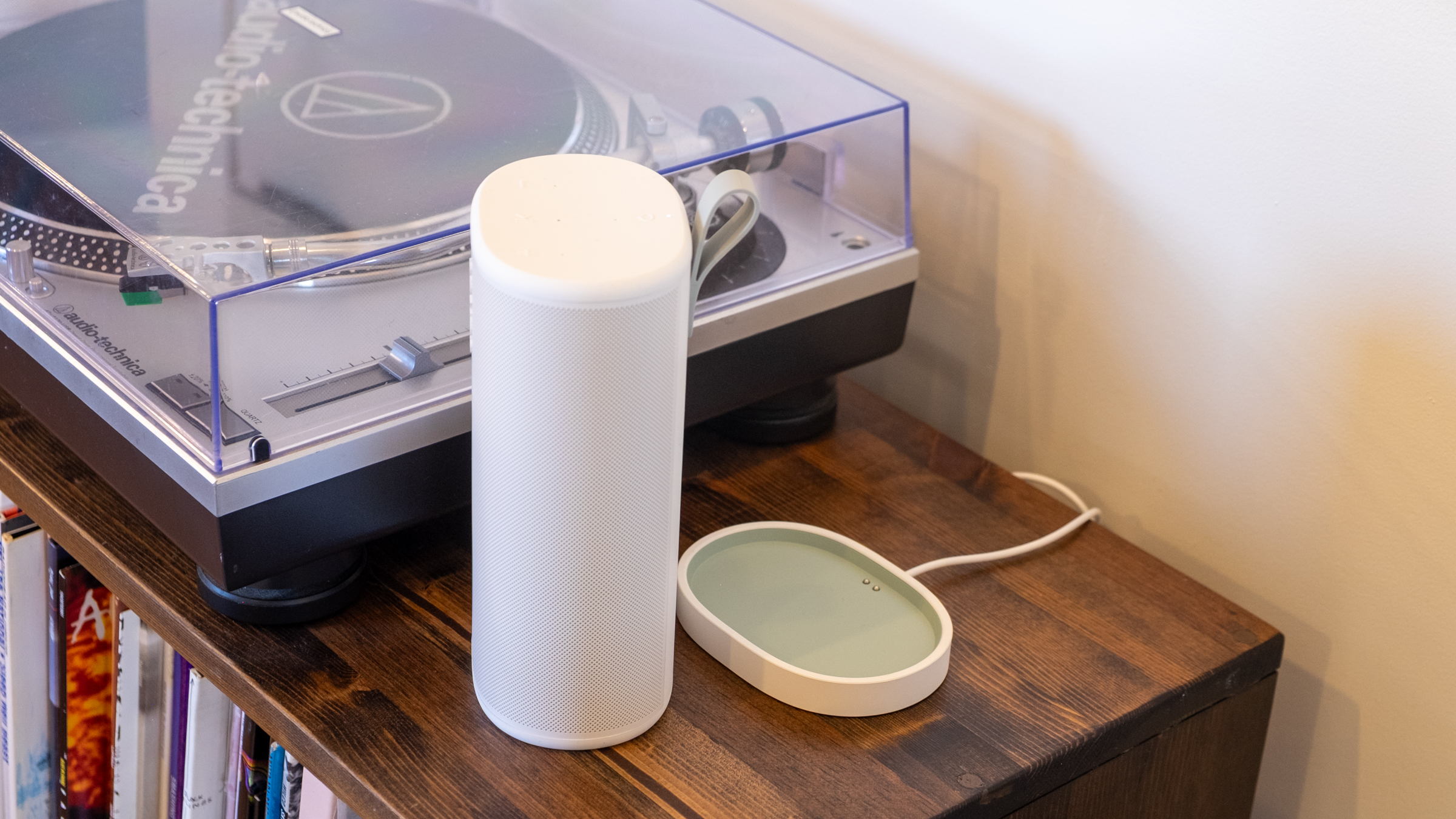
That’s all standard fare at this point, but I appreciate that Sonos included Ethernet and line-in capabilities, two things the Roam doesn’t support. It makes the Play a much more versatile option for being a centerpiece of your indoor setup as well as something you can take on the go. And since the Play comes with a wireless charging base, it’s easy to keep it charged up during indoor duty and equally simple to just grab it and go without fussing with cables. (Strangely enough, it does not come with a power adapter, so you’ll need to provide your own USB-C brick.)
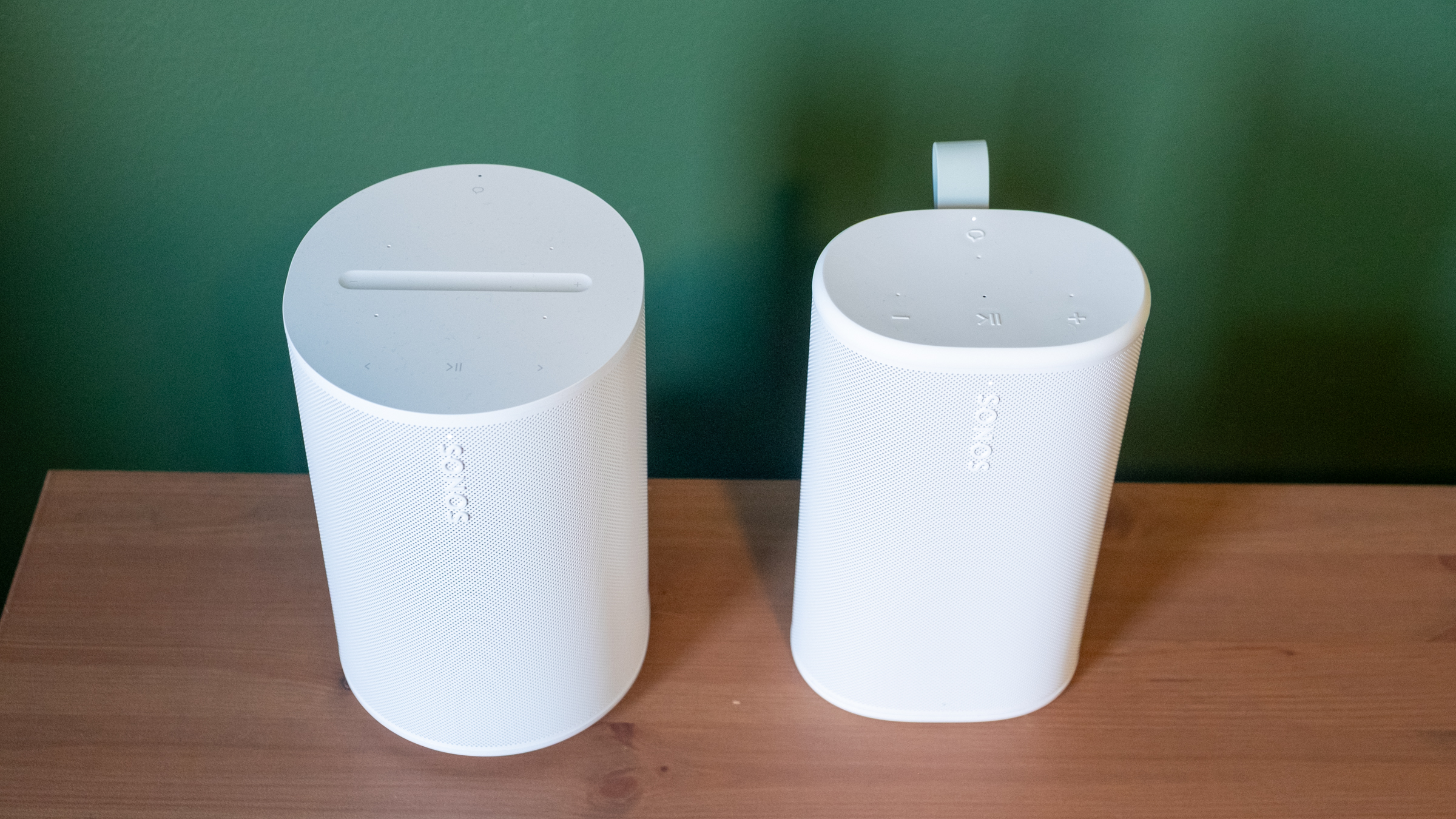
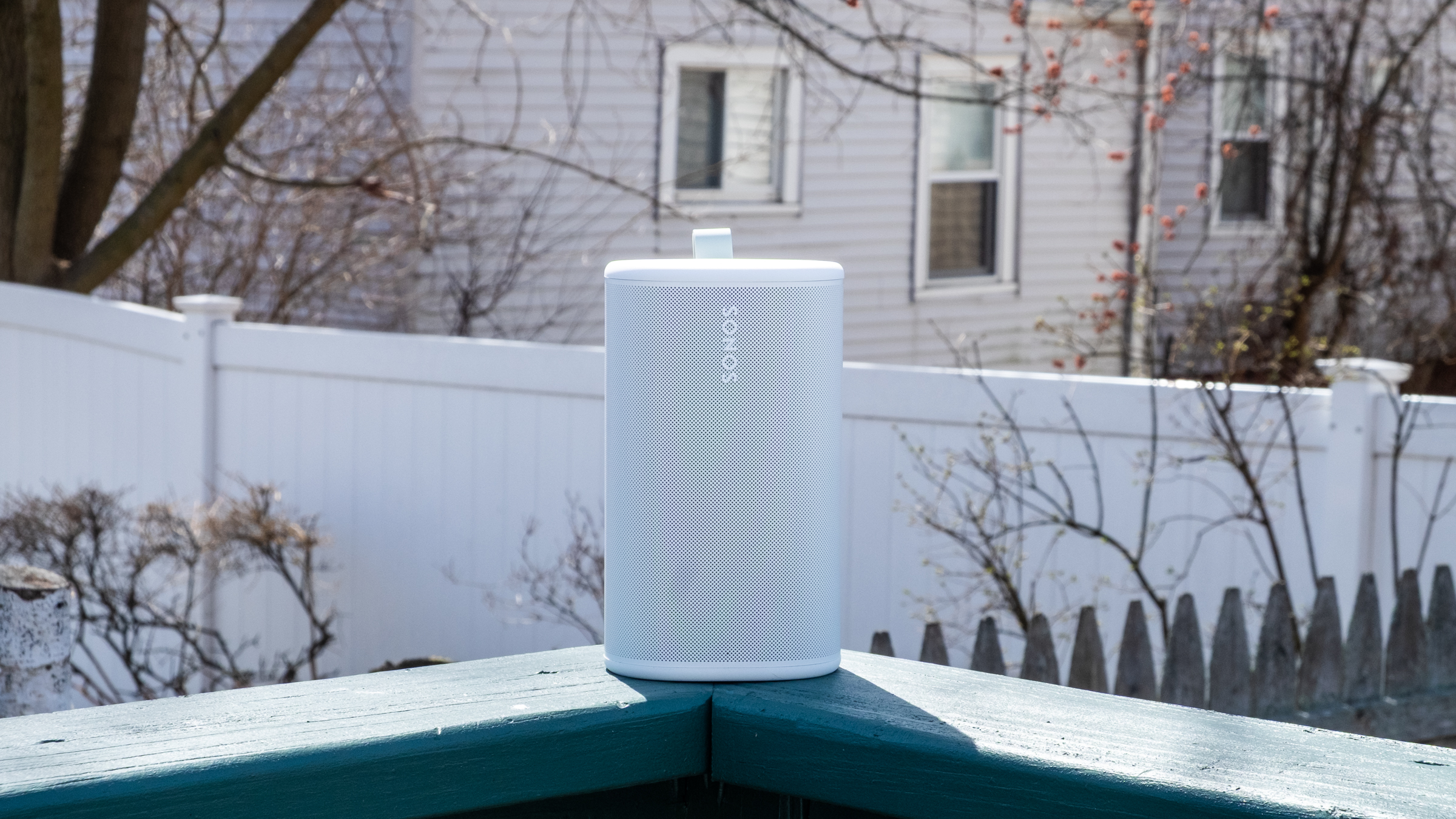
Physically, the Play reminds me of the Sonos Era 100 with its width squished down to make it more portable. Unsurprisingly, it comes in the same white and black color options; I had been hoping for a few more options like the vibrant Roam colors. The one touch of color you’ll see is on the light green grab loop attached to the back; you can remove it if you’re not a fan. At 7.6 inches, it’s slightly taller than the Era 100, but it’s much thinner and lighter. Based on the initial product renders, I expected the Play to be larger than it is in reality, but it feels quite compact and easy to move around. It’s not a “throw in your bag and forget it” speaker like the Roam, but it’s far more portable than the Move. The Move is a speaker I’d really only use in my house or in the backyard, whereas I’d toss the Play into a backpack and take with me — unless I really needed to save space or weight.
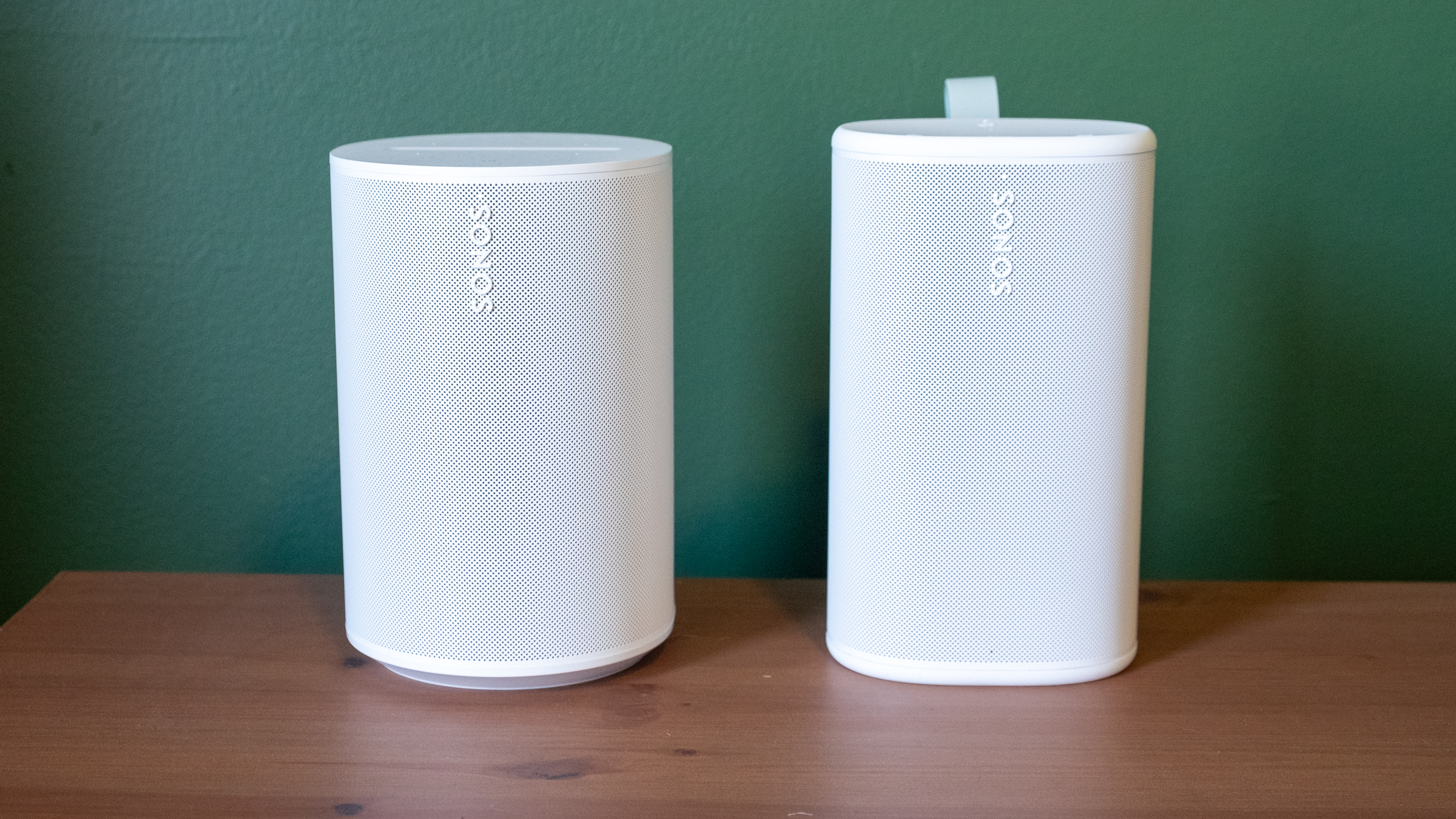
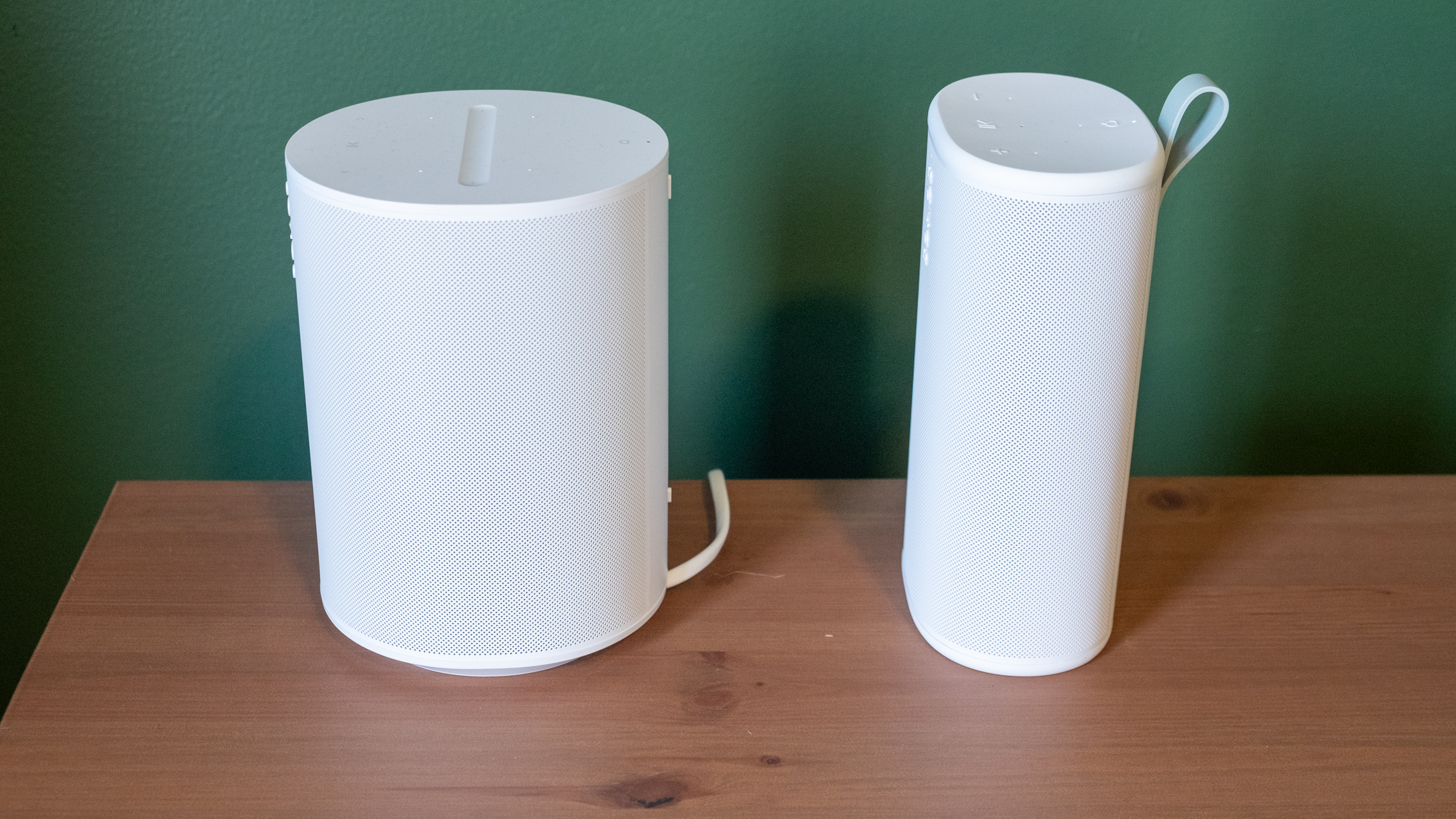
Its diminutive size is even more impressive when you consider the audio components Sonos packed inside. The Play features a speaker array nearly identical to that of the larger Era 100. It has two tweeters angled at 90 degrees for some stereo separation, along with a mid-woofer and two passive radiators for bass performance. The passive radiators are unique to the Play, specifically included to help bass levels in settings where there aren’t walls for the sound to reflect off of — like anywhere outside you might take a portable speaker.
Audio quality
The Play’s flexibility only matters if it sounds good. Fortunately, Sonos has never struggled with producing a speaker that’s a pleasure to listen to, and the Play certainly fits the bill. My top-level and unscientific analysis is that the Play sounds nearly as good as the Era 100, an impressive feat considering its comparatively small frame.
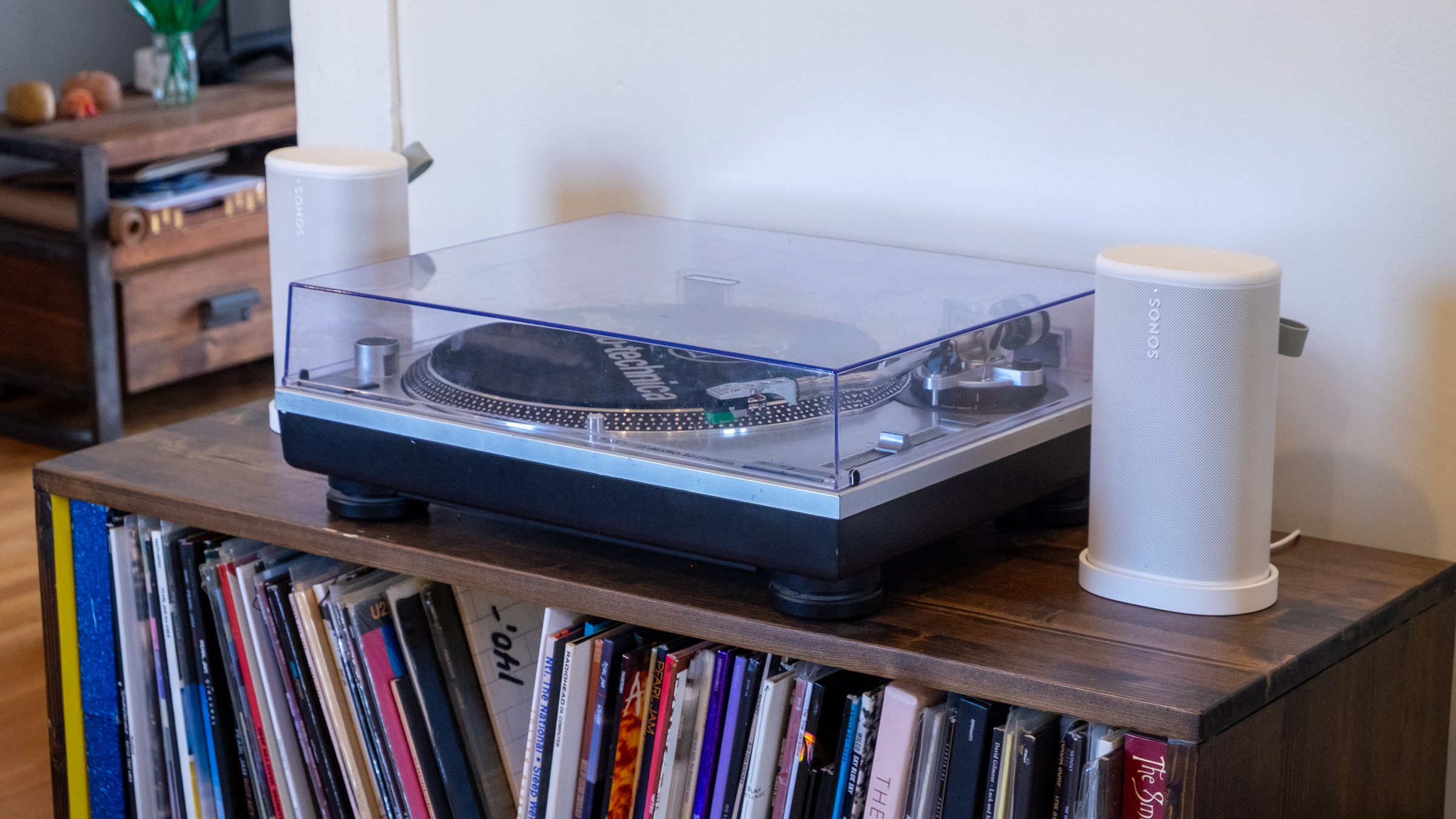
I tested a single Play speaker as well as a stereo pair in my small office, where I typically listen to music through a stereo pair of Era 100 speakers. I also used them in stereo on my larger and more open first floor, both streaming music and playing on my turntable via the line-in jack. Finally, I got to test them outside on my deck on a few lovely early Spring days that the Boston area was graced with recently. I used the auto Trueplay tuning feature throughout; it uses the Play’s built-in microphone to optimize audio for whenever you’ve placed the speaker. Sonos has offered various versions of Trueplay for over a decade now and it consistently makes its speakers sound better. And given you don’t have to do the old “wave your phone around the room” method to use Trueplay, there’s really no reason not to have it on.
While in my office, I did a lot of A/B testing of the Era 100 vs. the Play, typically playing Apple Music lossless via the Sonos app, but I also tried AirPlay and Spotify Connect as well as other music services including YouTube Music and Bandcamp. The biggest differences I noticed between the two speakers are the Era 100 is louder and has a more pronounced mid-range. The Play comparatively feels like its EQ is “scooped,” and it just isn’t quite as loud at the same volume level. The Play also doesn’t maintain quality quite as well through the full volume range — I wouldn’t say that it got distorted when I was playing it at 75 percent volume, but it’s not as clear as the Era 100 either.
These differences I mostly only noticed when I was flipping back and forth between the two speakers — when I just sat back and listened, I was extremely happy with the Play’s sound. When listening to a single Play, the angled tweeters did provide a small degree of stereo separation when things were hard-panned to the left or right channels. For example, the backing vocals in the chorus of Soundgarden’s “Black Hole Sun” jump from one channel to the other, and I did pick up on that effect.
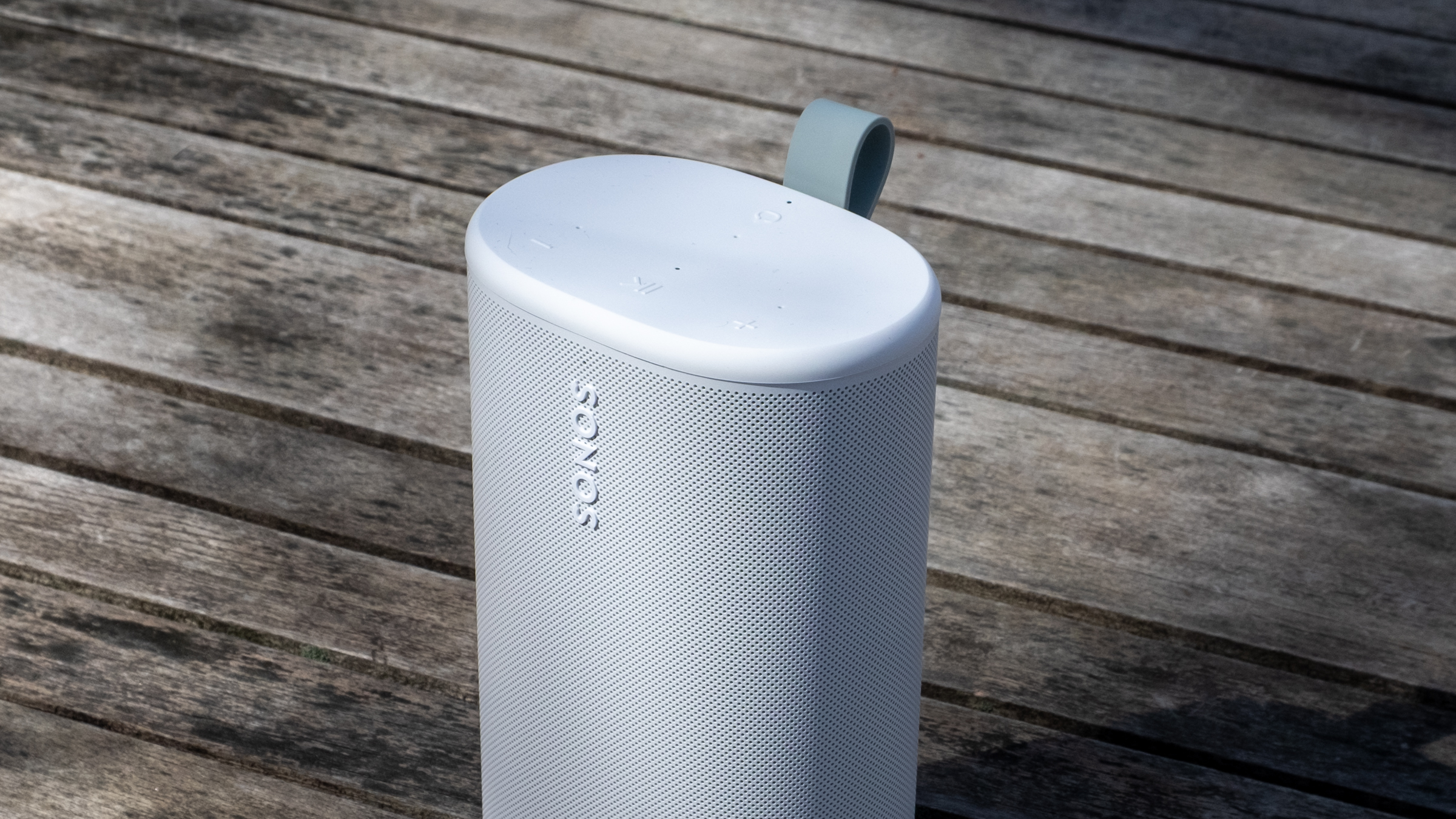
The Play sounds very well-balanced and neutral, capable of reproducing songs without over-emphasizing any particular frequency. My usual listening habits include a ton of ‘90s-era alternative and more modern indie rock, plus some modern pop and the occasional film or video game score, and the Play sounded great across the board. Daughter’s “Be On Your Way” is an atmospheric track juggling strings, electronic underpinnings, reverb-drenched guitar and a gorgeous vocal track, and all those elements shined here. The dance-influenced beats of Nine Inch Nails’ “Less Than” had appropriate thump and power behind them, and “Stay Down” by Boygenius sounded great, whether it was the acoustic-tinged intro or the layered, full-band climax. Heavier fare like Metallica’s “Battery” and Tool’s “Fear Inoculum” hit with the appropriate intensity as well, particularly when I was running two Play speakers in stereo.
My go-to film score for these kinds of tests is Howard Shore’s Lord of the Rings: The Two Towers, and it’s often the case that doesn’t sound as majestic on smaller speakers. But the Play did a great job with the intricate orchestral arrangements that jump between delicately intimate moments and full-throated majesty — the first song “Glamdring” has all these elements in less than four minutes, and it sounded excellent. I also love Gustavo Santaolalla’s score for The Last of Us with its tortured strings and host of organic acoustic sounds alongside unsettling electronics, and all its various elements were faithfully conveyed here.
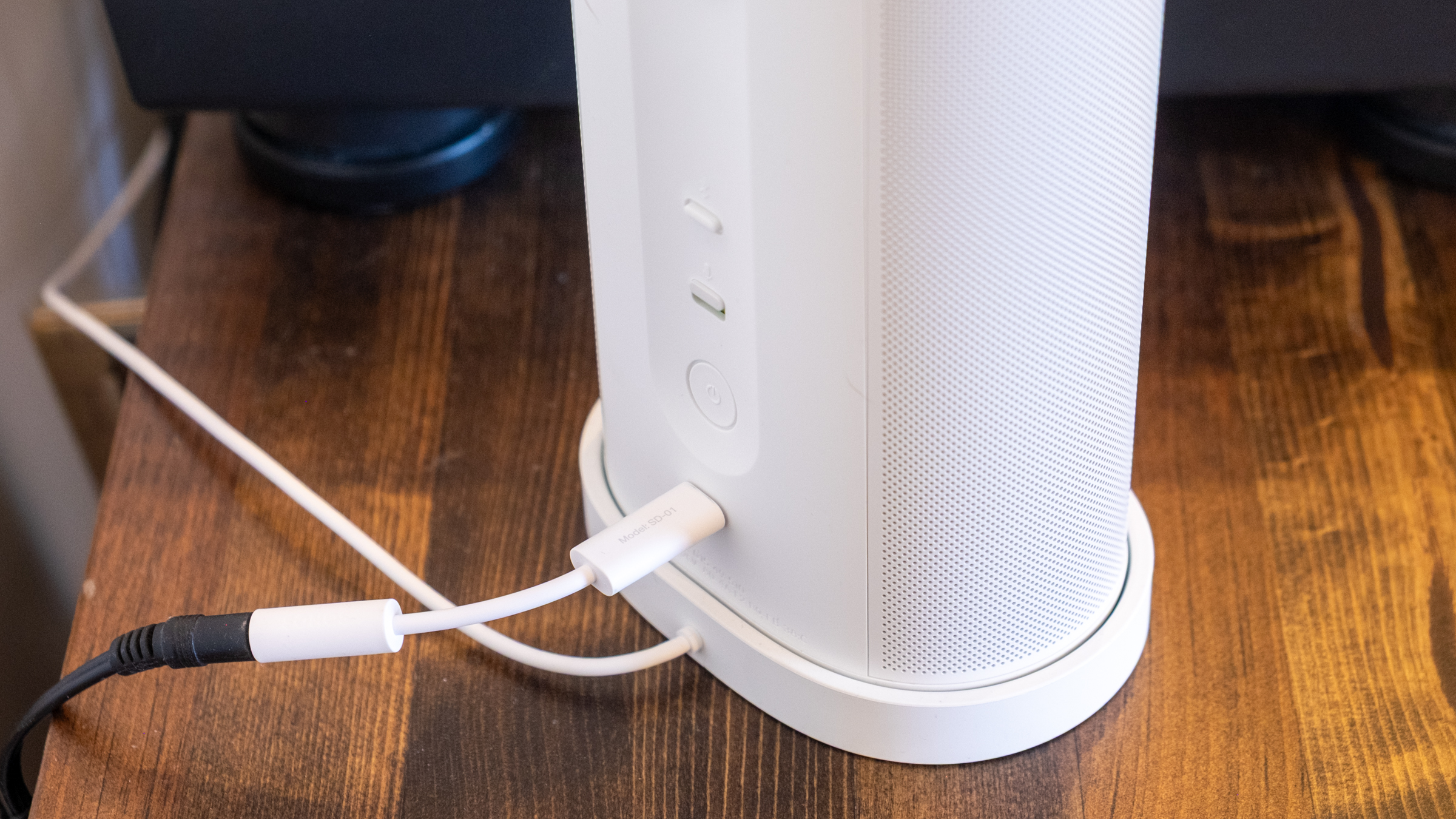
Using the speaker’s line-in capabilities with a USB-C to 3.5mm audio input worked easily as well. The only real issue I noticed is that my particular turntable’s output meant I had to turn the Play up much louder than I would when streaming music, so its top volume level is much lower. That wasn’t exactly a problem, but if you really want to push a lot of volume from a line-in source, this might not be the speaker for you. I was also worried that I’d switch from line-in to streaming and forget to adjust the volume down, but the speaker is smart enough to re-adjust from the line-in volume down to wherever it was set previously.
While the Play isn’t the loudest speaker out there, it has plenty of power when outside. I set the volume to around 60 and walked from my porch to the sidewalk and could still faintly hear the music (though not loud enough to be too offensive to passers-by or neighbors). Back up on the deck, the Play maintained its detailed profile despite the lack of surfaces for the sound to reflect off. It feels like a great device to have playing in the background when you’re entertaining outdoors, but something like the Move 2 will do better if you want music to be the centerpiece of a gathering.
The Play’s Wi-Fi connection is strong enough that I didn’t need to switch to Bluetooth when I was outside, but it’s simple to use if you need it. There’s a dedicated Bluetooth button on the back; pressing it turns it on, while holding puts the speaker in pairing mode. Bluetooth is probably the easiest way to give someone else control over your Sonos system. If you start streaming music to it, you can then group other speakers with the Play to get those tunes anywhere in the house without having to give a guest access to your Sonos system.
Sonos included a new Bluetooth feature with the Play that they’re also bringing to the Move 2. If you’re away from Wi-Fi and playing audio via Bluetooth, other Play or Move 2 speakers can join a group just by pressing and holding the play/pause button. This works with Play or Move 2 speakers that have previously been set up on the same Sonos system, and it’s as simple as it sounds. I just paired my phone to one speaker, started playing some music and then held the play/pause button on the second speaker to get them in sync.
As for battery life, the Play is a huge step up over the Roam’s rather paltry 10-hour estimate. The Play is rated for up to 24 hours of playback, same as the Move 2, and I think Sonos just about hit that mark. I spent several work days playing music for eight-plus hours and the Play’s battery only dropped about 30 percent each time. Your mileage may vary, but I think the Play has plenty of battery life considering its smaller size — and given how easy it is to just drop on a charging base when you’re done, I don’t think most people will run its battery down too often. Sonos also made the battery in the Play user-replaceable, a good option to keep the speaker running for years to come.
Competition
While there are loads of portable Bluetooth speakers out there, the Play’s position as a Wi-Fi speaker that can group with others in a household as well as be used on-the-go with Bluetooth makes it a rather unique option. The $269 Bose SoundLink Plus sounds great, can be paired in stereo or grouped in “party mode,” and is a similar size as the Play. But its battery doesn’t last as long and, more crucially, it only works via Bluetooth. Some people won’t care, but I prefer the much wider variety of playback options that the Play provides. JBL also has a host of portable Bluetooth speakers, as well as Wi-Fi enabled options meant for home use — but again, the combo of Wi-Fi playback and portability seems to be mainly limited to Sonos right now.
As such, the main competition for the Play comes from Sonos itself, with the Move 2, Roam and Era 100 all offering different pluses and minuses depending on what you’re looking for.
Wrap-up
If it isn’t obvious, I’m a pretty big fan of the Sonos Play. While it’s not quite as portable as the tiny Sonos Roam, it sounds significantly better than the smallest Sonos speaker while still being easy to carry around. It’s probably the most versatile speaker in the Sonos lineup right now, and a smarter choice than the $499 Move 2 for most people. Unless you really need massive outdoor volume, the Play is the best portable Sonos speaker.
The only catch is its price. $299 is fair when you consider its sound quality and feature set. But it’s also $80 more than the Era 100, or $110 more than the Era 100 SL (which drops the microphone but is otherwise identical to its more expensive counterpart). So you’ll have to decide how much portability is worth to you. For me, the Play is an excellent addition to my existing setup. But if you’re likely to do most of your listening indoors, the Era 100 and its superior sound quality might make more sense.
To be clear, that’s not a knock against the Play. The latest Sonos speaker offers impressive sound quality, flexibility and portability, and it’s the kind of product that can help Sonos rebuild its reputation after its recent difficulties.
This article originally appeared on Engadget at https://www.engadget.com/audio/speakers/sonos-play-review-the-companys-best-portable-speaker-so-far-130000688.html?src=rss
DJI Avata 360 drone review: 360 video hits new highs
26 Mar 2026, 12:00 pm by Steve Dent
After achieving action camera success, Insta360 invaded DJI’s turf with the first mass-market panoramic drone, the Antigravity A1. It had instant appeal for drone pilots, offering 8K 360 video and features like subject tracking, obstacle detection and FPV flying.
Though beaten to the punch, DJI has responded quickly with the Avata 360, aided by its drone experience and camera tech from the new Osmo 360 action cam. It has a lot in common with its rival, but it’s safer to fly around people and offers single camera 4K footage on top of 8K 360 video.
To find out how the Avata 360 stacks up against the A1, I tested it both indoors and out, around people and even “stunt” horses. The Avata 360 isn’t perfect, but it is far more polished than its rival. As with other DJI drones of late, though, US availability remains unclear.
How the Avata 360 works
The 360 camera makes the Avata 360 different from any other DJI drone. It features two ultrawide cameras with f/1.9 lenses and 1.1-inch 64-megapixel sensors, with one pointing up and the other down for unobstructed 200-degree views. Those are then stitched together by software to create 360 degree video at up to 8K 60 fps.
This setup fundamentally changes the way you pilot a drone and capture video. Since the 360 camera records everything around it, you can focus on flying and reframe shots later in DJI’s Studio app. That 360 view is also handy when piloting in FPV mode. With the head tracking on DJI’s Goggles N3, you can look all around you simply by turning your head.
Unlike the Antigravity A1 that only shoots 360 video, the Avata 360 supports regular single-camera shooting as well. When you switch to that mode, the camera rotates forward and shoots 4K video at up to 60 fps with a 28mm field of view. DJI’s drone also works with a regular controller, which isn’t an option on the A1. You have to use the Insta360’s goggles at all times.
Design
Because of the chunky 360 camera, the Avata 360 is slightly bigger than the Avata 2. It’s also quite a bit heavier at 455 grams (one pound) and so, unlike the 249-gram Antigravity A1, you’ll need a permit to fly one in most regions.
The Avata 360’s propellers are shielded to protect the drone and keep it safe indoors or around people, unlike the open-prop A1. For additional protection it has two omni obstacle sensors on the side, a Lidar sensor up front, landing sensors on the bottom and, of course, a camera that points in all directions. To keep the lenses off of bare ground, it comes with a foldable 18×18-inch landing mat.
DJI’s Goggles N3 (available with the RC Motion 3 controller as an option) are comfortable and allow you to wear eyeglasses. Unlike the Goggles 3, though, there’s no external camera to see outside. If you’d rather pilot conventionally, you can get the Avata 360 bundled with DJI’s RC 2 screen controller in another kit.
Performance and features
As an FPV drone, the Avata 360 is fast and agile. It can hit speeds up to 40 MPH in sport mode (without obstacle avoidance) or 35 MPH in normal mode. When used with the optional FPV Remote Controller 3, you can do flips, rolls and other “cinewhoop” style maneuvers. Once you get used to flying it that way, it’s incredibly fun.
The 38.7Wh batteries have 26 percent more capacity than the Avata 2’s cells, but rated endurance is about the same at 24 minutes. I never got more than about 18 minutes in real-world flying though, so it’s a good idea to buy the Fly More kit with three batteries and a fast charger that can replenish them all in about 100 minutes.
Part of my testing of the Avata 360 was capturing “trick riding” horses, so it was important that the drone noise didn’t spook them. At 81db the Avata 360 is louder than the Mini 4 Pro (67 db) and less banshee-like than the Neo 2 due to the larger propellers, so the horses weren’t alarmed.
Video is transmitted to the Goggles N3 and RC Motion 3 controller (or the RC screen controller) at 1080p 60 fps via DJI’s OcuSync 4.0+ system. The maximum flying range is 20 km (12.4 miles), double that of the Avata 2. This is an impressive distance for an FPV drone.
The 45GB of internal storage (42GB usable) can fill up quickly when you’re shooting 8K video, but the drone also has a microSD slot. To get your footage onto a PC or smartphone, you can transfer it via the USB-C port or over Wi-Fi using DJI’s Fly app.
The Avata 360 has DJI’s usual tracking and obstacle detection features, but they’re available only with the RC 2 controller and not the Goggles N3. To follow a subject, simply draw a box around them on the controller to enable Focus Track and its three modes: Spotlight, Point of Interest and ActiveTrack. The latter tracks a subject automatically and lets you control the drone’s position via an on-screen “steering wheel.”
To test that, I biked in a narrow forested lane and walked around a bamboo-covered obstacle course. When using Focus Track, the drone dodged most obstacles and was only confused by small leaves and branches. If it did contact one of those, it sailed right through without crashing thanks to the propeller guards.
Subject tracking works in both 360 and single camera modes, but when using the latter, The Avata 360 can’t see and avoid obstacles behind it. It contacted branches several times during my testing, but fortunately the prop guards prevented crashes. Other automatic features include Dronie, Rocket and Quickshot modes that let you capture clips for social media.
Video
The Avata 360 prioritizes FPV freedom and flexibility over pure video quality. Though the specs promise 8K, that only applies to the full 360 degree video — your final, flat video will actually be 4K or less after processing. And the 360 camera zooms digitally (not optically), which further reduces resolution. On top of that, you can often see a “seam” in the video where stitching occurs, and dewarping (used to output flat video) can create softness at the edges. With all that, video is less sharp than DJI’s regular Mini, Air and Mavic drones.
Because the camera is fixed when shooting 360 video, the Avata 360’s gimbal can’t smooth out jolts or correct for roll. Instead, it uses action cam-style electronic stabilization. What’s more, that type of smoothing causes motion blur and artifacts in low light due to the lower shutter speeds — something I also noticed with the Osmo 360.
With that said, video quality was as sharp and color-accurate as the Osmo 360, and a touch better than the Antigravity A1 when filming in daylight. For tricky, contrasty conditions like a shaded path on a sunny day, the D-LogM option boosted dynamic range, helping me bring out shadow detail and tone down overly-bright highlights. However, the cityscape I shot at night was soft and occasionally blurry due to the aforementioned stabilization issues.
In exchange for this lower video quality, the 360 camera provides incredible flexibility. For a vlog style tracking shot, for instance, I usually need to film twice to show the forward and backward directions. With the Avata 360, though, I was able to get both POVs from the same shot and output an overhead view too for good measure.
DJI Studio is where you go to select your desired framing and output the flat video. It’s not quite as versatile as Insta360’s app, but it allows you to reframe shots and create smooth transitions between camera angles. And to save time, you can use the Intelligent Tracking feature to center your subject. The app also offers color correction and other features, but I found it easier to export the final shots to DaVinci Resolve for any additional work.
Flat video a mixed bag. Sharpness is mildly better than the 360 video, but the lack of a gimbal roll axis means that the camera can’t level itself when the drone banks into the wind. As a result, most of my footage was tilted and often unusable.
Wrap-up
With the Avata 360, DJI has a surprisingly sophisticated drone that offers better video quality and more features than its only rival, Insta360’s Antigravity A1. It can do everything you’d expect from a DJI FPV drone like tracking, obstacle avoidance and acrobatics, while operating safely around people (or horses).
DJI also managed to undercut Insta360 on price, with the Avata 360 starting at 459 euros (approx. $530), or 939 euros ($1,089) in a kit with a screen controller, three batteries and a charger. It’s also available with the extra batteries and charger, DJI’s FPV Goggles N3 and the RC Motion 3 controller for 939 euros ($1,089). As mentioned, there’s no word yet on US pricing, but the Avata 360 has been approved by the FCC so it could appear in the US soon.
Like 360 action cams though, this is a niche product. If you’re a vlogger, extreme action shooter, FPV pilot or solo filmmaker who wants speed and flexibility, the Avata 360 is a great choice. If it’s pixel perfect image quality you want, however, you’re better off with DJI’s Mini 5 Pro, Air 3S or Avata 4 Pro drone.
This article originally appeared on Engadget at https://www.engadget.com/cameras/dji-avata-360-drone-review-360-video-hits-new-highs-120014666.html?src=rss
OpenAI drops plans to release an adult chatbot
26 Mar 2026, 11:31 am by Steve Dent
OpenAI has "indefinitely" abandoned plans to release an a erotic chatbot for adults following concerns from employees and investors, the company confirmed to The Financial Times. Plans for such a feature, first announced in October 2025 for release in December last year, had already been delayed while company debated whether to release it all. It's the second app OpenAI has decided to shelf this week, after announcing on Tuesday that it was shutting down its Sora video generator.
The adult-oriented chatbot, reportedly called "Citron mode," is now on hold with no planned release date. The company reportedly had difficulty training models that previously avoided erotic content and also removing illegal behavior like bestiality or incest, two people familiar with the matter told the FT.
Open AI said that it wanted to conduct long-term research on the effects of erotic chats and user attachment to AI, adding that there was currently not yet enough "empirical evidence" on the subject. The company also said it wanted to focus on its core productivity tools like coding assistants and drop "side quests" like Sora and the erotic chatbot.
The idea for adult features came after OpenAI announced that it would add parental controls and automatic age detection features for ChatGPT. CEO Sam Altman said back in October that the company had always been careful about such issues over concerns around unhealthy AI attachments, but felt comfortable that it could "safely relax the restrictions in most cases."
However, the adult mode had reportedly caused concern among investors, particularly amid the controversy caused by rival xAI's Grok model that generated deepfake nudes of real people and children. Staff also worried about the feature, with one senior employee even leaving the company over the issue. "AI shouldn’t replace your friends or your family; you should have human connections," he told the FT.
Another challenge is OpenAI's age-checking tech, introduced following lawsuits from families who said that ChatGPT harmed their children. The tech reportedly has an error right higher than ten percent, which would still give a large number of young people access to the tech. OpenAI said that figure is in the industry standard range and that it is continuing to work on its accuracy.
This article originally appeared on Engadget at https://www.engadget.com/ai/openai-drops-plans-to-release-an-adult-chatbot-113121190.html?src=rss
Uber and Pony.ai are testing a robotaxi service for Europe
26 Mar 2026, 10:48 am by Mariella Moon
Uber and Chinese company Pony.ai are gearing up to launch a robotaxi service for Europe, starting with Zagreb in Croatia. The companies are working with Croatian company Verne, which will provide the service ecosystem and operational framework for the service. They’re using Arcfox Alpha T5 vehicles made by Beijing-based automaker BAIC Motor powered by Pony.ai’s Gen-7 autonomous driving system. Initially, the autonomous rides will be offered on Verne’s app, but they will eventually be available through Uber.
In their announcement, the companies said they have already started on-road testing in Zagreb, where the service will be available “soon.” They’re hoping to expand it to other European cities in the future, and then to more markets, with the goal of deploying a fleet with thousands of robotaxis over the next few years. Verne will be in charge of securing regulatory approval for the rollouts, while Uber has agreed to invest in the Croatian company.
This is but one of Uber’s partnerships centering around its efforts to offer more and more driverless rides to its passengers. Just earlier this month, it announced that it was launching a pilot program for a robotaxi service in Tokyo in late 2026 with Nissan and UK self-driving startup Wayve. Uber also started offering robotaxi rides to passengers in Las Vegas at the same time. The fleet deployed in the city is made up of Hyundai Ioniq 5 autonomous EVs, developed in partnership with Motional.
This article originally appeared on Engadget at https://www.engadget.com/transportation/uber-and-ponyai-are-testing-a-robotaxi-service-for-europe-104811944.html?src=rss
Oversight Board tells Meta expanding Community Notes outside of US poses 'significant' risks
26 Mar 2026, 10:00 am by Karissa Bell
Meta didn't consult its Oversight Board last year when it announced sweeping policy changes to content moderation and a rollback of third-party fact checking in the United States in favor of Community Notes. But the company did ask the board for advice on how to expand the crowd-sourced fact checks to other countries.
Now the Oversight Board is publishing its advice to Meta. In a 15,000-word policy advisory opinion, the group urged Meta to be cautious with an international rollout, warning that an expansion of the program could "pose significant human rights risks and contribute to tangible harms" if safeguards are not put in place.
The board, notably, was asked to weigh in on a fairly narrow set of questions, including how it should evaluate whether to withhold the feature in certain countries. Meta "respectfully" asked the Oversight Board to avoid "general" critiques about the system, which it has said is modeled after X.
In its opinion, the Oversight Board said that Community Notes "could enhance users’ freedom of expression and improve online discourse" with enough safeguard. But it recommended Meta withhold the feature in countries with "high polarization," as well as countries in the midst of a crisis or "protracted conflict." The board also said that Meta should avoid countries with a history of organized disinformation networks, because the notes may be more easily manipulated in such places, and countries with "linguistic complexity" that Meta may be ill-equipped to understand.
Depending on how you interpret that advice, that could exclude quite a few countries, though the board stopped short of making country-specific recommendations. Still, it raises questions about how closely Meta will follow the suggested guidelines. For example, the United States could be considered a country with "high polarization." (Community Notes has been live in the US for more than a year.)
While the Oversight Board was careful to say it "neither endorses nor opposes" an expansion of Community Notes, it did discuss Meta's approach to fact checking, noting that its partnerships with outside fact-checking organizations are still largely in place outside of the US. And the opinion cautions against ending these relationships, noting that research into Community Notes on X shows that authors writing notes often rely on work done by professional fact checkers.
"Community Notes and fact checking are not mutually exclusive," Oversight Board member Paolo Carozza tells Engadget. "One doesn't have to replace or substitute for the other, they can coexist. And in some situations, there are really important reasons for them to coexist. The board really deliberately stayed away from any kind of suggestion that the introduction of Community Notes ought to result in the removal or ending of fact checking."
This article originally appeared on Engadget at https://www.engadget.com/social-media/oversight-board-tells-meta-expanding-community-notes-outside-of-us-poses-significant-risks-100000213.html?src=rss
End of today’s Engadget roundup.