This digest compiles the latest from The Verge.
Today’s The Verge Roundup
My dream pair of AR gaming glasses needs to have these nine features
4 Apr 2026, 2:00 pm by Cameron Faulkner

I’ve spent months in the lab testing the latest AR glasses from Xreal and Viture. By “lab,” I mean cozied up on my couch each night, playing my Steam Deck or Nintendo Switch 2 on a huge, virtual screen that only I can see through these glasses.
Using AR glasses as a portable display for your handhelds (and other USB-C devices, like phones, tablets, and laptops) is nothing new. However, the latest versions have one must-have feature in common: three degrees of freedom, or 3DoF, which lets you anchor the screen anywhere you’d like, as opposed to having it nauseatingly wiggle with every head movement. This won’t make AR glasses worth their $400-plus costs for most gamers. But this makes them more useful if you travel a lot, or if you want a more ergonomic handheld setup.
I tested three popular models — Xreal’s $449 1S, its $649 One Pro, and Viture’s $549 Beast — and there is no best pair that everyone should buy. Each does a few things well and a few things not so well, which leaves me no other choice than to list out the ingredients that would make for one perfect pair of AR glasses for gaming.
The comfort, sound quality, and ease of use of Xreal’s glasses
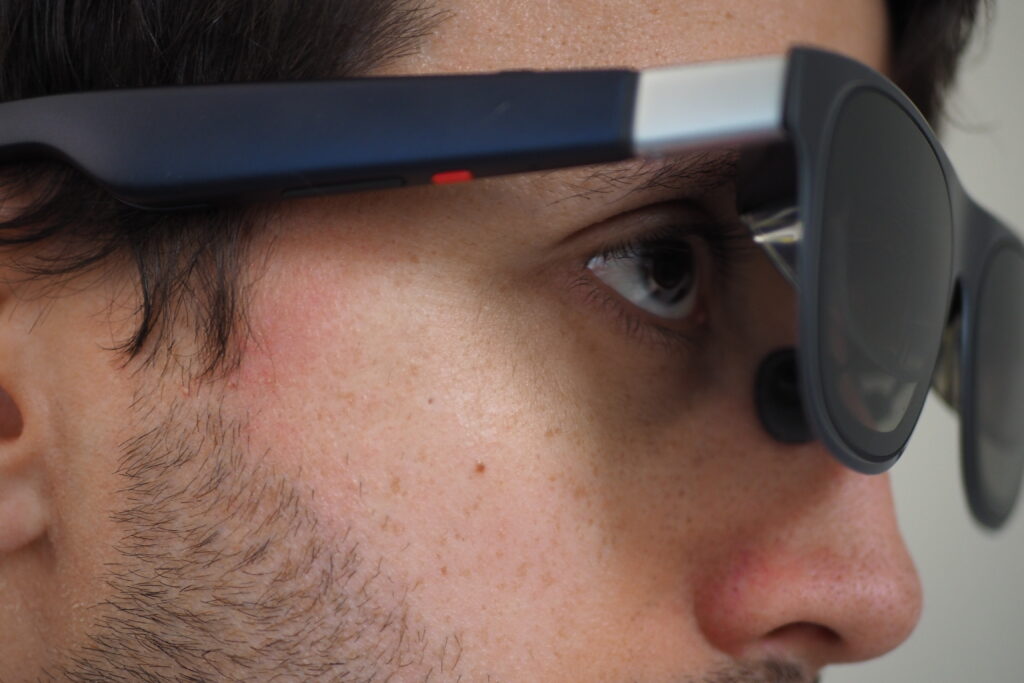
All of these AR glasses are heavier and thicker than regular glasses, but Xreal’s 1S glasses are the lightest model of the bunch. On my kitchen scale, they weigh 85 grams (for comparison, the One Pro glasses weigh 91 grams, while the Viture Beast glasses are 96 grams). A small thing that’s actually a big deal is that they (as well as the One Pro) have great weight distribution and thinner temple arms than Viture’s Beast, which helps me feel less strain on my ears. It’s great that Xreal’s most affordable AR glasses are just as comfortable as its most expensive pair.


The 1S and One Pro glasses deliver better-sounding audio through their temple arms than Viture’s latest glasses. Xreal’s audio is tuned by Bose, and the glasses have balanced audio with surprisingly good low-end performance. Viture’s is tuned by Harman, and the Beast glasses pack considerably less oomph, with more emphasis on the mids and highs. Music, movies, and games are all more fun to listen to through Xreal’s glasses, even at low volumes.
The 1S and One Pro glasses have fewer buttons than Viture’s glasses, which lowers the learning curve. Xreal’s glasses have four buttons in total, all of which are along their right temple arm. To be fair, all AR glasses’ button layouts take a while to learn. But the Beast has six in total spread across both temple arms, two of which are a button rocker dedicated solely to adjusting the opacity of its electrochromic lenses — it’s overkill.
The superior contrast and clarity of Viture’s Beast glasses
The three pairs of AR glasses that I tested use similar Sony micro-OLED screens, but Viture’s glasses are my favorite when it comes to displaying games with the same rich contrast, inky blacks, and bright highlights as would appear on the OLED TV in my living room. Just as important, picture quality looks great regardless of where you use these glasses because their optics cut down on reflections (however, they’re not “4K-like,” as Viture misleadingly advertises). The Xreal One Pro glasses are also fantastic in terms of picture quality and exhibit next to no reflections due to having high-end optics, but they’re typically $100 more — though sometimes just $50 — than Viture’s Beast.


Unfortunately, the Xreal 1S’s biggest weakness is reflections. Bright rooms make their OLEDs exhibit crushed blacks, looking more like LCDs in these scenarios. They can produce a good image in low-light scenarios, though content appears blurrier through them than with the other glasses.
The great fit and finish of Xreal’s glasses
Xreal is peerless when it comes to build quality, and its $449 1S feels just as high-end as its pricier One Pro. Both pairs have snappy metal hinge mechanisms that prevent their temple arms from opening unintentionally (the ones on Viture’s Beast quickly swing open and feel cheap). Moreover, Xreal’s glasses look more like real sunglasses than the Beast glasses do (Viture can’t resist going with a slightly gamer-y look that you’ll love or hate, though the Beast glasses look much more sophisticated than its Luma series). Yes, these traits are indistinguishable once they’re on my face, but they’re worth considering given their high cost.
The user experience is more polished across the board with Xreal’s glasses. My Steam Deck and phone are a few seconds faster to connect to the Xreal 1S and One Pro, and as mentioned before, the learning curve is lower. Xreal also currently has the better 3DoF implementation simply because the screen stays put when it’s anchored. With the Viture Beast glasses, the “anchored” screen moves, slowly sliding out of view. That’s a deal-breaker.
Xreal’s Real3D feature, which is better than I expected (in small amounts)
Xreal glasses that have the X1 chip (ones that launched in the past two or so years) now have the Real 3D feature. The mode can turn 2D content into 3D, and there’s a multi-step software slider to increase its effect. I enjoy using its mildest conversion setting more than I expected to.
The 3D effect is not as pronounced as the Nintendo 3DS’s 3D effect, but the subtle improvements are easy to notice. It works especially well in games that don’t require a ton of fast movement.
Viture’s Switch 2 compatibility
Unfortunately, no AR glasses can connect with a single USB-C cable to the Switch 2 (blame Nintendo). You need a compatible dock, one of which doesn’t exist just for Xreal glasses owners. The company canceled its Neo charging dock it announced at CES 2026 due to reliability concerns (the unit it sent me for testing still works great with my console). So, folks with Xreal glasses and a Switch 2 will need a different accessory to play.


It’s easier if you have Viture’s glasses, but not exactly affordable. Viture makes a $130 Pro Mobile Dock that works perfectly with the Switch 2 for the Beast. This dock doubles as a 13,000mAh battery so you can charge up while you game. If the Switch 2 isn’t your thing, the dock features a full HDMI port, letting you view a console’s video feed within your glasses. Video passthrough works for Xreal glasses, too, but audio didn’t work well enough for me to recommend it.
Xreal 1S

Score: 7
| Pros | Cons |
|---|---|
|
|
Where to Buy:
Xreal One Pro

Score: 8
| Pros | Cons |
|---|---|
|
|
Where to Buy:
Viture Beast

Score: 6
| Pros | Cons |
|---|---|
|
|
Where to Buy:
Photography by Cameron Faulkner / The Verge
Really, you made this without AI? Prove it
4 Apr 2026, 1:00 pm by Jess Weatherbed

“This looks like AI.”
It’s a phrase I dread seeing as a writer who dabbles in illustration and amateur photography. In a world where generative AI technology is increasingly adept at mimicking the work of humans, people are naturally skeptical when online platforms refuse to label even obvious AI content.
This leads me to one conclusion: maybe we should start labeling human-made text, images, audio, and video with something akin to a universally recognized Fair Trade logo. The machines sure as hell aren’t motivated to label their work, but the creators at risk of being displaced most definitely are.
Fortunately, I’m not alone in my thinki …
The app for tracking TV, movies, podcasts, and everything
4 Apr 2026, 12:00 pm by David Pierce

Hi, friends! Welcome to Installer No. 122, your guide to the best and Verge-iest stuff in the world. (If you’re new here, welcome, go ‘Zona, and also you can read all the old editions at the Installer homepage.)
This week, I’ve been reading about early Apple employees and weather apps and one-page productivity systems, watching Avatar: Fire and Ash on my phone in installments the way James Cameron intended, trying and failing to find a better Gmail address than the dumb one I picked 20 years ago, watching the Artemis II launch because space is awesome, buying a new mug that was too expensive but is extremely awesome, replacing my work soun …
Super Meat Boy 3D makes suffering fun
4 Apr 2026, 12:00 pm by Jay Peters

The original Super Meat Boy is one of the best-known indie games of all time. Released in 2010, it’s a brutally difficult 2D platformer, but so fun to play: The short levels almost feel like speedrunning puzzles, and even though they’re filled with traps and buzzsaws, dying isn’t so bad because you revive nearly instantly. Super Meat Boy 3D has much of the same spirit; it’s just as infuriating, and just as satisfying.
Moving around as Meat Boy in 3D feels very similar to 2D, particularly his really floaty jump. Wherever you run (and where you die) you leave blood splatters, which are helpful visual reminders of where to go (or where you die …
Anker’s Nebula P1 projector is the portable sound king
4 Apr 2026, 7:00 am by Thomas Ricker

The Soundcore Nebula P1 from Anker isn’t the most portable Google TV projector I’ve ever reviewed, nor is it the brightest. It doesn’t even have a built-in battery. Instead it’s a decent video device that focuses on sound.
The Nebula P1’s standout feature is a pair of speakers that detach to create true left- and right-channel separation. It sounds much better than typical all-in-ones like the supremely portable TCL PlayCube, Xgimi MoGo, or Anker’s popular Capsule projectors.
I’ve been testing the $799 (currently on sale for $639) Nebula P1 as I travel around the European countryside in my van. It’s not my favorite portable projector, but …
End of today’s The Verge roundup.