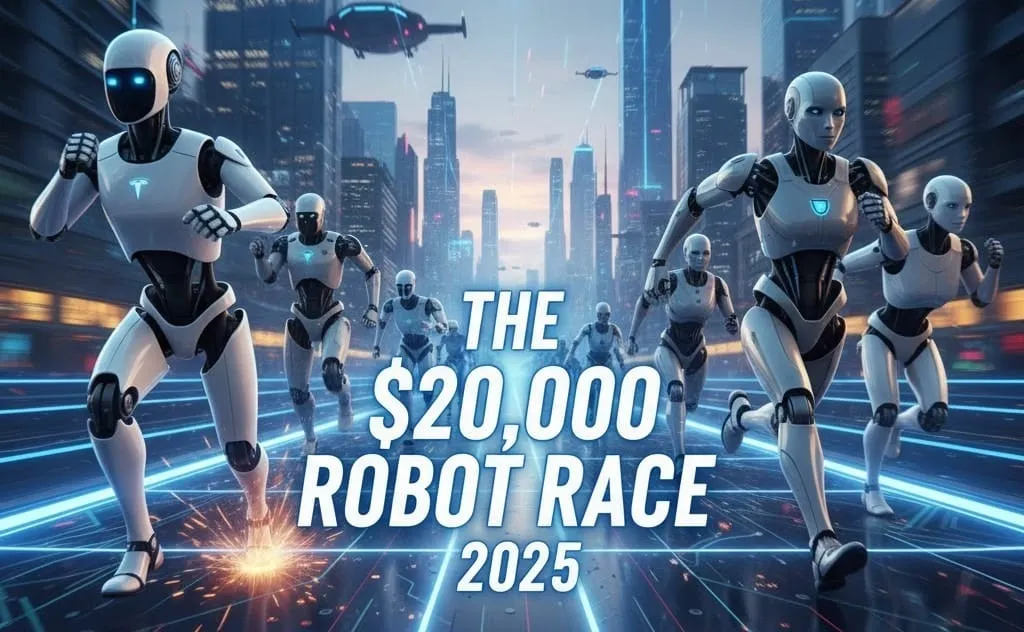
For decades, science fiction promised us a future where robotic companions would walk among us—doing our laundry, building our cars, and keeping us company. For just as long, the reality has been disappointing: multi-million dollar specialized machines that were too dangerous to be near and too stupid to fold a shirt.
That changed in late 2025.
We have officially crossed the “Model T” threshold for robotics. Just as Ford made the automobile accessible to the masses, four major players—1X Technologies, Tesla, Unitree, and Figure AI—are racing to bring functional humanoid robots to the price point of a mid-sized sedan. This is a critical psychological and economic barrier.
But there’s also a fifth, legendary contender: Boston Dynamics’ Atlas. While Atlas represents the absolute pinnacle of humanoid performance, its multi-million dollar development cost keeps it firmly in the realm of research labs, far from the $20,000 consumer market. Yet, it serves as the ultimate benchmark, the audacious dream these more accessible robots are striving towards.
In this comprehensive guide, we are going deep into the “Five Contenders” of 2025: The 1X NEO, the Tesla Optimus Gen 3, the Unitree G1, the newly revealed Figure 03, and the awe-inspiring Boston Dynamics Atlas.
1. The “Home Assistant”: 1X NEO
The Gentle Butler Built for Your Living Room
If you are dreaming of the “Rosie the Robot” lifestyle, the 1X NEO is currently the only machine that genuinely wants to fulfill that promise. Backed by the AI juggernaut OpenAI, 1X Technologies has taken a radically different approach to robot anatomy that sets the NEO apart from every other machine on this list.
The “Soft” Anatomy Revolution
Most robots are built like tanks: rigid metal skeletons, high-torque motors, and hard plastic shells. If a rigid industrial arm accidentally swings into a human, it breaks bones.
NEO is different. It utilizes muscle-like anatomy powered by tendon drives rather than traditional gear motors.
- How it works: Instead of a motor directly spinning a joint (like a drill), NEO uses motors to pull cables (tendons) that move the limbs. This mimics human biology.
- The Safety Factor: This “soft” actuation allows the robot to be “compliant.” If a child runs into NEO, or if you grab its arm to stop it, the robot yields instantly. It doesn’t fight the external force; it absorbs it. This passive safety is the “killer app” for home robots. You don’t need safety cages or emergency stop buttons; the robot’s very physics makes it safe to hug.
Embodied AI: The “Show, Don’t Code” Interface
The biggest friction point in home robotics has always been programming. You cannot code a robot to “clean the messy room” because “messy” looks different every day.
NEO runs on “Embodied AI” (often powered by models similar to OpenAI’s GPT-4o but for physical movement). It learns through visuomotor imitation.
- The Training Process: You don’t write code. You enter “VR Mode” (using a headset and controllers provided by 1X). You see through NEO’s eyes and move its arms with your own. You fold a shirt as the robot.
- The Learning Curve: After you guide it through the motion a few times (perhaps 50 times for a complex task, or fewer for a simple one), the neural network “clicks.” It understands the goal is “folded shirt,” not just “move arm 3 inches left.”
- Generalization: Once it learns to pick up a red cup, it can figure out how to pick up a blue mug. This ability to generalize is what makes it a “Home Assistant” rather than a pre-programmed toy.
Silence is Golden
One feature often overlooked in tech specs is noise. Industrial robots whine, click, and whir. The 1X NEO is engineered for silence. Its tendon drives and lack of heavy gears allow it to operate at a whisper-quiet level. If you are watching a movie while NEO tidies up the kitchen in the background, you shouldn’t hear the servo-whine that plagues other bots.
The Reality Check
- Price: $20,000 (Early Access).
- Timeline: Pre-orders opened late 2025, but don’t expect it under your Christmas tree until 2026.
- Limitations: It is not a heavy lifter. It’s designed for laundry, dishes, and tidying—not moving furniture.
2. The “Industrial Powerhouse”: Tesla Optimus (Gen 3)
The Blue-Collar Worker for the Electric Age
Elon Musk’s entry into the robotics space was initially met with skepticism (remember the dancer in the spandex suit?), but the Tesla Optimus Gen 3 has silenced the critics. This is not a butler; this is a laborer. Tesla’s goal is not to make you coffee, but to solve the global labor shortage.
The 22-DoF Hands: A Engineering Marvel
The crown jewel of the Gen 3 Optimus is its hands. The human hand is an evolutionary masterpiece, and replicating it is notoriously difficult.
- Degrees of Freedom (DoF): The Gen 3 hand features 22 degrees of freedom. For context, a standard industrial gripper has 1 or 2. This allows Optimus to perform sub-millimeter precise tasks.
- Tactile Sensing: It’s not just about movement; it’s about feeling. The fingertips are embedded with advanced tactile sensors that allow the robot to feel the “slip” of an object. It can hold a raw egg without crushing it or a heavy drill without dropping it, adjusting grip strength in milliseconds.
The “FSD” Brain
Tesla’s biggest advantage is that it has already solved the navigation problem. The Optimus robot uses the same Full Self-Driving (FSD) computer and occupancy network found in Tesla cars.
- Occupancy Networks: Instead of seeing “lanes” and “cars,” the Optimus sees “walkable paths” and “obstacles.” It builds a real-time 3D vector space of the factory floor.
- Cost Efficiency: Because Tesla produces these chips and cameras by the millions for their cars, they can put supercomputer-level inference hardware into a $20,000 robot. No other robotics company has this supply chain advantage.
The “Human in a Robot Suit”
Elon Musk has famously claimed that the Gen 3 will move so naturally that “it won’t even seem like a robot.”
- Fluidity: Early robots walked with a bent-knee “Groucho Marx” walk to maintain balance. The Gen 3 Optimus has achieved a much more natural, straight-leg gait, increasing walking speed and energy efficiency.
- Teleoperation vs. Autonomy: A point of controversy in 2025 has been the ratio of teleoperation (human remote control) to autonomy. While Tesla demos often show autonomous tasks, complex new tasks are initially done via teleoperation to gather training data. Buyers should be aware that the “fully autonomous worker” is still a software update away.
The Reality Check
- Price: Target $20k–$25k (Long term). Early models likely higher or internal-only.
- Status: Mass production has begun, but strictly for internal Tesla use. The “Tesla Bot” you see in videos is likely working on a Model Y assembly line. Consumer availability is the “later goal,” likely late 2026 or 2027.
- Vibe: It’s sleek, faceless, and utilitarian. It doesn’t have eyes to look at you; it has cameras to look past you.
3. The “Available Now” Researcher: Unitree G1
The Agile Acrobat You Can Buy Today
While 1X and Tesla are taking pre-orders and making promises, Unitree Robotics (China) did something radical: they just shipped the product. The Unitree G1 is the wild card of 2025—a robot that defies the “human-sized” norm to offer something faster, cheaper, and weirder.
The “Kid-Sized” Advantage
The G1 stands at roughly 4’2″ (1.27m). It looks less like an adult human and more like a futuristic child or a large hobbit.
- Why Small is Good: By reducing the size, Unitree reduced the weight and torque requirements. This means smaller motors, less battery drain, and lower costs.
- Agility: The G1 is a stuntman. It can perform standing long jumps, recover from violent kicks, and even fold itself up into a compact box (roughly the size of a checked suitcase) for transport. This “foldability” makes it the only humanoid robot you can toss in the trunk of a sedan.
The $16,000 Price Tag
Unitree shocked the industry with a starting price around $16,000.
- How they did it: Unitree leveraged the supply chains from Shenzhen and their history of building “Robodogs” (the Unitree Go series). They are masters of driving down hardware costs.
- The Trade-off: At this price, you aren’t getting the 22-DoF hands of the Tesla (unless you pay for the pro version) or the soft-touch safety of the NEO. You are getting a robust, metal, high-torque machine.
The Developer Platform
The G1 is explicitly positioned as a platform for developers and researchers.
- Not a Butler (Yet): Out of the box, the G1 doesn’t know how to fold your laundry. It knows how to walk, run, and balance. It is up to you (or third-party software developers) to write the “laundry folding” app.
- The App Store Model: Unitree is betting that by making the hardware cheap and available, a community of developers will invent the use cases. They are selling the iPhone; they are waiting for someone else to build “Uber.”
The Reality Check
- Price: Starts $16,000 (EDU versions go higher).
- Status: Available now.
- Vibe: It feels like high-end lab equipment. It’s impressive, slightly intimidating, and screams “high performance.”
4. The “Premium” Independent: Figure 03
The Robot That Broke Up with OpenAI
For a long time, Figure AI was known as “the other OpenAI partner.” That changed in late 2025. In a dramatic pivot, Figure AI ended its exclusive partnership with OpenAI to build its own brain, Helix, and released the Figure 03.
The “iPhone” of Robots
If Tesla is the “Android” (utilitarian, mass-market), Figure 03 is trying to be the Apple product.
- Design Shift: The Figure 03 has moved away from the chrome industrial look of its predecessor (Figure 01) to a sleek, matte-black finish with soft materials covering its joints. This signals a major pivot from “factory only” to “home ready.”
- Helix VLA: By building their own AI model (“Helix”) instead of relying on OpenAI’s generic models, Figure claims to have achieved “end-to-end” reasoning that is faster and more reliable for physical tasks. It doesn’t just “chat”; it “does.”
The “BotQ” Factory
Figure isn’t hand-building prototypes anymore.
- Mass Manufacturing: They have launched a dedicated facility called “BotQ” to print these robots.
- Specs: It features a massive battery upgrade (2.2x energy density) and 16-degree-of-freedom hands that are nearly as good as Tesla’s.
The Reality Check
- Price: Premium Tier (Speculated $50k+ initially for B2B, targeting $20k consumer later).
- Status: Commercial pilots / Waitlist.
- Vibe: It feels like a luxury product. Sleek, expensive, and highly capable.
5. The “Dream Machine”: Boston Dynamics Atlas
Pinnacle of Performance (Beyond Your Budget)
While the other four contenders battle for your $20,000, Boston Dynamics’ Atlas exists in a league of its own. It’s not a commercial product, nor will it be hitting the market at any price point near our focus. Instead, Atlas is a research platform that has pushed the boundaries of humanoid locomotion, balance, and agility to astonishing levels.
The Gymnast & The Parkour Master
Atlas is famous for its breathtaking demonstrations of dynamic balance and athleticism.
- Unrivaled Agility: Backflipping, vaulting, complex parkour courses, even navigating rough terrain with human-like grace. Atlas’s hydraulic actuation gives it incredible strength-to-weight ratio and precise control.
- Robustness: Unlike many research robots that fall and break, Atlas is built to withstand repeated falls, quickly getting back up to continue its task.
Why No Price Tag (or a Multi-Million Dollar One)?
- Pure Research: Atlas’s purpose is to explore fundamental questions about robotics, not to be sold. Every component is custom-built and optimized for performance, not cost.
- Complexity: It’s an incredibly complex machine, requiring highly specialized technicians and a controlled environment. It consumes massive amounts of power and makes significant noise due to its hydraulic system.
- The Benchmark: Atlas shows what’s possible. It sets the standard that other companies are working years to even approach, proving that human-level mobility can be achieved, even if the path to commercialization is long and arduous.
The Reality Check
- Price: Effectively priceless for consumers. Multi-million dollar development cost per unit.
- Status: Research platform only. Not for sale.
- Vibe: Awe-inspiring, intimidating, and a glimpse into the far future.
Comparison: Which Droid Are You Looking For?
Now that we’ve met the contestants, how do they stack up against each other?
| Feature | 1X NEO | Tesla Optimus | Unitree G1 | Figure 03 | Atlas |
| Core Philosophy | Safe Home Assistant | Efficient Factory Worker | Agile Research Platform | The “Premium” All-Rounder | Pinnacle of R&D |
| Key Technology | Tendon-driven “muscles” | 22-DoF Hands & FSD AI | High-torque joint motors | “Helix” VLA Brain | Custom Electric Actuators |
| Height | Human-sized (5’5″) | Human-sized (5’8″) | Compact (4’2″) | Human-sized (5’6″) | Human-sized (5’0″) |
| Safety Profile | Passive safety (soft body) | Industrial safety (sensors) | Active balance (agile) | Hybrid (Soft materials) | Experimental / Industrial |
| Best For | Families, chores, elderly care | Logistics, heavy lifting | Devs, tech enthusiasts | High-end Industry & Home | Pure Research & Agility |
| Availability | Pre-order (2026 Delivery) | Internal Tesla Use | Available Now | Commercial Pilots / Waitlist | Not for Sale |
The “Fine Print”: What 2025 Buyers Need to Know
Before you rush to drop a deposit on a $20,000 android, it is vital to look past the slick marketing videos. In the world of late 2025 robotics, the sticker price is just the entry fee. Here is the reality of living with the first generation of humanoids.
1. The “RaaS” Trap (Robot as a Service)
The most important thing to understand is that for companies like 1X and Figure AI, the hardware is likely a loss leader. Selling a robot for $20,000 barely covers the cost of the motors, battery, and sensors.
So, how do they make money? Subscriptions.
- The “Brain” Tax: These robots don’t just run on local chips; they rely on massive cloud compute to process “Embodied AI” and complex reasoning. Expect to pay a mandatory monthly fee (estimated between $200 and $500/month) for “intelligence services.”
- The Brick Risk: If you stop paying the subscription, your sophisticated butler might revert to being a very expensive, remote-controlled statue. You are not just buying a machine; you are marrying a SaaS ecosystem.
2. Battery Anxiety is Real
The Achilles’ heel of humanoid robotics remains energy density. Despite massive leaps in battery tech by Tesla and Figure:
- The Runtime Reality: Most of these bots have a runtime of 2 to 4 hours of active work.
- The Nap Schedule: This means for every afternoon of cleaning, your robot needs 60-90 minutes on the charger. You aren’t getting a 24/7 servant who scrubs floors while you sleep; you are getting a part-time helper who needs frequent naps.
3. The “Wizard of Oz” Effect (Teleoperation)
When you watch a viral video of a robot folding a shirt perfectly, ask yourself: Is it thinking, or is it being driven?
- Teleop: Many impressive feats shown in demos are achieved via teleoperation (a human wearing a VR rig controlling the robot remotely).
- You Are the Trainer: Early adopters in 2026 won’t just be users; they will be data collectors. You will likely spend the first few months “driving” your robot through tasks (via VR or a controller) to teach it the layout of your specific home. You are paying $20,000 to be a beta tester.
4. Privacy in the Living Room
This is the conversation nobody wants to have yet. To navigate your home, these robots use 360-degree cameras, LiDAR, and microphones.
- Mapping Data: To function, the robot creates a millimeter-accurate 3D map of your home. Where does that data go?
- The Cloud Question: For Tesla, that data helps train FSD. For 1X, it trains the foundation model. Unlike a Roomba that bumps into walls, these robots recognize objects, read text on papers left on desks, and see you in your pajamas. Review the data privacy policy carefully before you let the cameras roll in your bedroom.
5. Right to Repair? Good Luck.
If a joint motor fails on your Unitree G1 or a tendon snaps in your 1X NEO, you cannot just take it to a local repair shop.
Downtime: Expect maintenance downtime to be measured in weeks, not days.
Proprietary Tech: These are highly complex, proprietary machines. Repair will likely require shipping the entire 150lb unit back to a service center or paying for a specialized technician to visit.
Conclusion: The Year of the Hardware
2025 will be remembered as the tipping point—the year the hardware finally caught up to the software.
For the last three years, we have had the “Brains.” Large Language Models like GPT-4 and Gemini gave us AI that could think, write, and reason. But they were trapped in chat windows. They were ghosts in the machine.
Now, with the arrival of the 1X NEO, Tesla Optimus, Unitree G1, and Figure 03, we finally have the “Bodies” that are within grasp for a burgeoning market. And in the background, the Boston Dynamics Atlas continues to redefine what humanoids are capable of, inspiring the next generation of engineers.
The choice of which robot defines 2025 depends entirely on who you are:
- For the Coder: If you want to write code today and don’t mind a machine that looks like a science experiment, the Unitree G1 is your sandbox. It is the Raspberry Pi of humanoids.
- For the Investor: If you are betting on the total transformation of the global supply chain and manufacturing, Tesla Optimus is the only game in town. It is the Model T of labor.
- For the Family: If you want a helper that can safely exist around your toddler or your cat, the 1X NEO is the only responsible choice. It is the first true appliance for the post-labor home.
- For the Futurist: If you want the premium, integrated experience—the “Apple” approach to the android—keep your eyes on Figure 03.
- For the Purist: If you don’t care about buying one, but simply want to witness the absolute bleeding edge of agility and physics, Boston Dynamics Atlas is the Formula 1 car to the others’ daily drivers.
The $20,000 question is no longer “Can they build it?” The question is now: “What will you teach it to do?”
Disclaimer: Robotics specifications change rapidly. Prices and release dates mentioned are based on late 2025 announcements and are subject to change by manufacturers.
Share via: