The Economic Factors Influencing Gamer Purchasing Decisions
Understanding Supply and Demand Dynamics
The recent trend of gamers opting for cheaper GPU options over high-end models can be attributed to various economic factors. One key aspect is the supply and demand dynamics in the GPU market. The scarcity of GDDR7 memory, a critical component in high-performance GPUs, has led to a shortage in the supply of high-end GPUs. As a result, manufacturers like NVIDIA have been forced to prioritize the allocation of GDDR7 to their higher-end products, such as the RTX 5080 and 5090, over more affordable models.
This strategic decision has significant implications for the pricing of high-end GPUs. With the limited availability of GDDR7, NVIDIA can command higher prices for their premium products, making them less accessible to the average gamer. Furthermore, the company’s decision to discontinue the program designed to keep gaming GPUs near MSRP pricing has allowed prices to fluctuate based on market demand, leading to even higher costs for consumers.
The Role of Consumer Behavior in Shaping Market Trends
Consumer behavior plays a crucial role in shaping market trends, and the GPU market is no exception. Gamers who continue to purchase NVIDIA’s high-end GPUs despite the exorbitant prices are, in effect, reinforcing the company’s pricing strategy. This phenomenon can be attributed to the psychological concept of anchoring, where consumers perceive the value of a product based on its price, rather than its actual performance or features.
Moreover, the lack of competition in the high-end GPU market has allowed NVIDIA to maintain its premium pricing strategy. With limited alternatives available, gamers who require top-of-the-line performance are willing to pay a premium for NVIDIA’s products, further solidifying the company’s market position.
The Technical Advantages and Limitations of High-End GPUs
Architecture and Performance Comparison
High-end GPUs like the NVIDIA RTX 5080 and 5090 boast advanced architectures and significant performance improvements over their mid-range counterparts. These GPUs feature enhanced CUDA cores, increased memory bandwidth, and support for cutting-edge technologies like ray tracing and artificial intelligence.
However, the technical advantages of high-end GPUs come at a cost. The increased power consumption, heat generation, and noise levels associated with these products can be significant drawbacks for gamers who prioritize quiet operation, low power consumption, or compact system builds.
Real-World Applications and Industry Trends
High-end GPUs have numerous applications beyond gaming, including professional visualization, scientific computing, and artificial intelligence. The demand for these products in these industries has driven innovation and investment in GPU technology, with manufacturers continually pushing the boundaries of performance and power efficiency.
According to a report by Tom’s Hardware, NVIDIA’s decision to cut the program designed to keep gaming GPUs near MSRP pricing has significant implications for the industry. As prices continue to rise, gamers may be forced to explore alternative options, such as mid-range GPUs or competing products from AMD.
The Impact of NVIDIA’s Pricing Strategy on the Gaming Community
Community Reaction and Alternative Solutions
The gaming community has been vocal about NVIDIA’s pricing strategy, with many expressing frustration and disappointment over the high costs of high-end GPUs. In response, some gamers have turned to alternative solutions, such as purchasing last-generation GPUs or exploring options from competing manufacturers.
Others have opted for mid-range GPUs, which offer a balance between performance and affordability. The NVIDIA RTX 3060, for example, provides excellent performance for 1080p and 1440p gaming, making it an attractive option for gamers who do not require the absolute highest performance.
Future Predictions and Emerging Trends
As the GPU market continues to evolve, we can expect to see significant changes in the way manufacturers approach pricing and product positioning. The rise of cloud gaming and game streaming services may reduce the demand for high-end GPUs, as gamers increasingly opt for more affordable, subscription-based solutions.
Moreover, the development of new technologies like artificial intelligence and machine learning may lead to the creation of more efficient, cost-effective GPUs. As these technologies mature, we can expect to see significant improvements in performance, power efficiency, and affordability.
The Role of Emerging Technologies in Shaping the Future of GPUs
Advances in Manufacturing and Materials Science
Emerging technologies like 3D stacking, quantum computing, and advanced materials science are poised to revolutionize the GPU industry. These innovations have the potential to significantly improve performance, reduce power consumption, and increase the affordability of high-end GPUs.
For example, the development of new materials like graphene and nanomaterials may enable the creation of more efficient, high-performance GPUs. Similarly, advances in 3D stacking and packaging technologies may allow for the integration of multiple GPUs into a single package, enabling significant performance improvements and reduced power consumption.
Comparison of Frameworks and Development Tools
The development of new frameworks and tools is also crucial in shaping the future of GPUs. Next.js, Nuxt.js, and Nest.js are popular frameworks used for building high-performance, scalable applications. These frameworks provide developers with the tools and resources needed to create efficient, GPU-accelerated applications, further driving the demand for high-end GPUs.
In conclusion, the trend of gamers skipping high-end GPUs for cheaper options is a complex phenomenon driven by a combination of economic, technical, and social factors. As the GPU market continues to evolve, we can expect to see significant changes in the way manufacturers approach pricing, product positioning, and innovation.
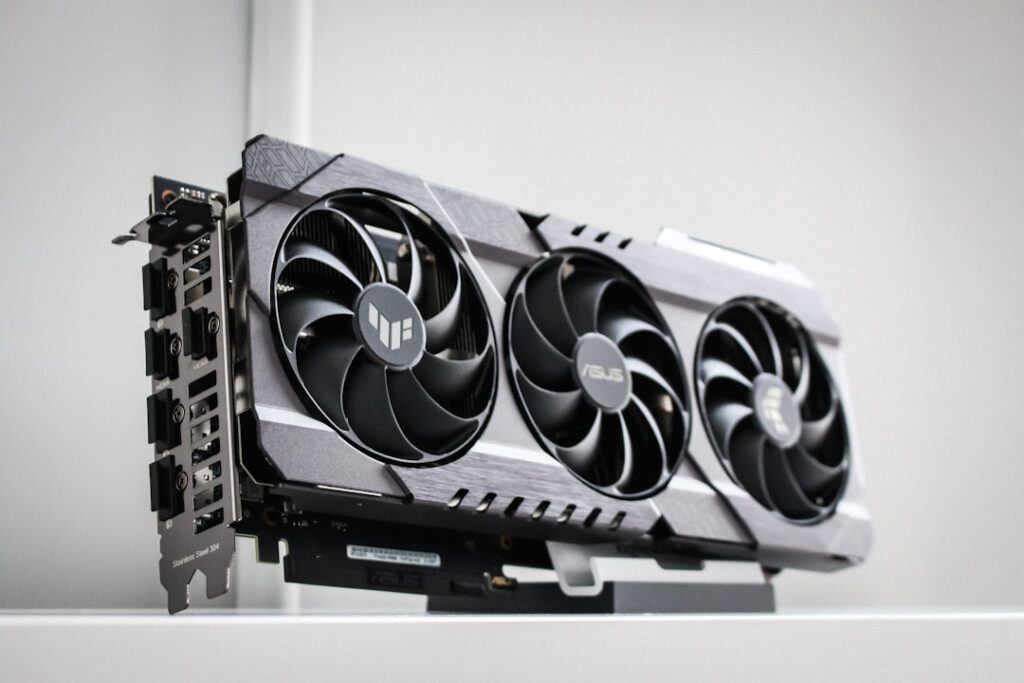
Photo by Thomas Foster on Unsplash
Share via: