This digest compiles the latest from Engadget.
Today’s Engadget Roundup
Snap is laying off 16 percent of its workforce, blames AI
15 Apr 2026, 4:24 pm by Matt Tate
Snap is laying off around 1,000 staff, amounting to 16 percent of its workforce, which it will seemingly replace with AI. The cuts were announced in a company-wide memo from CEO Evan Spiegel, who added that more than 300 open roles are also being closed.
Spiegel said the "incredibly difficult" decision would likely save Snap more than $500 million by the second half of 2026, in turn helping it to "establish a clearer path to net-income profitability." Impacted staff were notified by email and the company’s North America-based team were instructed to work from home. Snap said it would provide four-month severance packages to those affected by the layoffs, as well as healthcare and other entitlements.
"While these changes are necessary to realize Snap’s long-term potential, we believe that rapid advancements in artificial intelligence enable our teams to reduce repetitive work, increase velocity, and better support our community, partners, and advertisers," Spiegel wrote. "We have already witnessed small squads leveraging AI tools to drive meaningful progress across several important initiatives, including Snapchat+, enhanced ad platform performance, and efficiency improvements in our Snap Lite infrastructure."
Snap laid off around 20 percent of its employees in 2022, with further cuts made in 2023 and 2024. It follows in the footsteps of a number of tech companies laying off employees in favor of AI in a move to boost efficiency, including Amazon, Fiverr, Microsoft and Pinterest in the last year. Snap is expected to launch the consumer version of its Specs AR glasses later this year, and recently span off the brand into its own business.
This article originally appeared on Engadget at https://www.engadget.com/big-tech/snap-is-laying-off-16-percent-of-its-workforce-blames-ai-162456069.html?src=rss
Shoe company pivots to AI compute in sign of a totally normal and healthy economy
15 Apr 2026, 4:14 pm by Lawrence Bonk
The shoe company Allbirds, famous for its wool trainers, is pivoting to AI. You read that right. The San Francisco company has plans “to pivot its business to AI compute infrastructure, with a long-term vision to become a fully integrated GPU-as-a-Service and AI-native cloud solutions provider.” It’s also changing its name to NewBird AI.
This is subject to shareholder approval, with a vote scheduled for May 18. Once approved, the company will raise $50 million from an unnamed investor to assist with this enterprise. This money will be used for the “acquisition and monetization of graphics processing units, related high-performance computing infrastructure capable to support high workloads and other related assets.” In other words, all of the things one would need to start an AI compute company.
Allbirds, the shoe brand, now says it’s an AI compute company. pic.twitter.com/MRAG2LXyY9
— Tracy Alloway (@tracyalloway) April 15, 2026
Allbirds has always been known as an eco-friendly shoe company and, well, there’s no real way to do AI while protecting the environment. The company plans on getting rid of any eco-friendly branding, with stockholders being asked to approve a charter amendment proposal to “remove references to the company being operated for the environmental conservation public benefit.”
Investors absolutely love AI, despite rising public sentiment against the technology. To that end, the announcement that Allbirds was transitioning from shoes, a product category it has a decade of experience in, to AI compute, a product category it has no experience in, shot the stock up by over 400 percent. Financial Times has suggested this uptick will be short-lived and that retail investors should stay away.
Allbirds was once valued at $4 billion. It just struck a deal to sell most of itself for $39 million. https://t.co/DsX89JdtEM
— The Wall Street Journal (@WSJ) March 31, 2026
This pivot to AI cloud compute is surprising and, frankly, bizarre, but something drastic was bound to happen to Allbirds at some point. The shoe company was once riding high, with a valuation of around $4 billion as recently as 2021. It sold its shoe business and branding to an investment firm earlier this month for just $39 million.
Allbirds isn’t the only company pivoting to compute in an effort to feed the hungry goblin called AI. Boom Supersonic is a startup trying to build the world’s fastest airliner but has begun selling gas turbines to AI companies to power data centers. Many Bitcoin mining centers have pivoted to AI and it’s worth remembering that NVIDIA’s GPUs were once used primarily for PC gaming.
This article originally appeared on Engadget at https://www.engadget.com/ai/shoe-company-pivots-to-ai-compute-in-sign-of-a-totally-normal-and-healthy-economy-161449196.html?src=rss
Traeger debuts Westwood smart pellet grills that start at $700
15 Apr 2026, 4:04 pm by Billy Steele

Traeger gave backyard pit masters something more affordable last year with the Woodridge, but now the company is back with an even more budget-friendly option. With the Westwood series, the company offers very basic pellet grill functionality with a simplified controller and a no-frills design. You’ll still get Wi-Fi connectivity that works with the company’s app, and the Westwood grills are compatible with Traeger’s rail-based accessories. As you might expect at the $700 and $800 prices, there are a number of caveats compared to the company’s more expensive options.
The new Westwood grills have an even more streamlined controller than the Woodridge models. A button-based interface replaces the knob, with buttons for increasing and decreasing temperatures, both wired and wireless food probes, Wi-Fi and ignition. The side-mounted hopper has an 18-pound pellet capacity and there are shelves on the left side and underneath the cooking chamber. Inside, a two-tier setup offers either 653 or 823 square inches of cooking space, depending on which Westwood model you opt for.
The Westwood remains a set-it-and-forget-it device. The Wi-Fi connectivity allows you to keep tabs on cooking sessions from anywhere with the Traeger app. You can do everything from low-and-slow smoking to roasting and grilling with the 180-450 degrees Fahrenheit temperature range. There’s also a front rail for the company’s Pop and Lock accessories, which include a folding front shelf.
Of course, with the lower price comes a number of sacrifices. There’s no mention of Super Smoke or Keep Warm modes that Traeger offers on some of its more expensive grills. The Westwood only supports one wired food probe, so you’ll have to plan accordingly there. If you’re willing to spend an extra $80, these new grills do connect with Traeger’s wireless meat probe, so you at least have an option for additional food monitoring. Lastly, there’s no mention of a pellet sensor inside the hopper, which is a handy component for keeping track of your fuel supply.
While Traeger has consistently focused on midrange and premium pellet grills in recent years, the Westwood and Westwood XL are now the company’s most affordable options. These new grills will replace the popular Pro series in Traeger’s lineup. What’s more, new affordable options come at time when the company faces financial troubles and is currently in the midst of an ongoing restructuring.
The Westwood and Westwood XL are now available from grill retailers including Ace Hardware.
This article originally appeared on Engadget at https://www.engadget.com/home/kitchen-tech/traeger-debuts-westwood-smart-pellet-grills-that-start-at-700-160448450.html?src=rss
The Vivo X300 Ultra is a powerful camera phone aimed at videographers
15 Apr 2026, 4:00 pm by Mat Smith
Chinese phonemaker Vivo has been pushing the limits of smartphone photography in the last few years. However, the availability of its phones — like last year’s X200 Ultra, with its beefy add-on telephoto — has been intermittent in the West.
The company says the X300 Ultra its first global flagship launch, although there’s still no word on a US launch or pricing at the time of writing. Like the latest phones from Xiaomi and Oppo, Vivo is also obsessing over larger camera sensors, peripherals and a dizzying array of technical photography specs, with a particular focus on cinematic video recording.
Collaborating with Zeiss again, the X300 Ultra features a “triple prime lens” camera system with 85, 35 and 14mm equivalent focal lengths. This can be punched up to 400mm equivalent with a new telephoto extender, the messily-named Zeiss Telephoto Extender Gen 2 Ultra, whose price is also unknown for now.
Even without that add-on, Vivo has built its 85mm equivalent 200-megapixel telephoto camera to handle most of your zoom-heavy shooting moments. A “gimbal-grade” APO (apochromatic) camera is designed to correct color fringing and stabilize your shots. These are both typical issues when using higher zoom levels. In a dedicated “snapshot” mode, Autofocus tracking will even work at 60 fps, which I’m excited to test, as the phone can also shoot at up to 12 fps. Vivo says its optical image stabilization can correct up to three degrees of movement.
Other cameras are similarly powerful, spec-wise. The 35mm equivalent Zeiss “Documentary” camera uses a 1/1.12-inch 200MP Sony sensor and is apparently engineered for strong low-light performance and portrait shooting, with an f/1.8 aperture. Finally, there’s a 50MP ultrawide rounding out the camera lineup.
All three rear cameras support up to 4K 120fps 10-bit log video and the same in Dolby Vision. Vivo says the X300 Ultra will capture “film-like” color performance without the need for editing. If you want to dig into editing, however, it supports 10-bit log video for more dynamic range and color depth.
Vivo is going hard on video capture. The X300 Ultra's new “pro video mode" has an upgraded monitoring feature that supports users’ custom LUTs, showing a real-time preview of how it will look while recording in log. Vivo’s log format is also compatible with ACES workflow, making it easier to integrate the X300 Ultra alongside other cinema cameras.
To make it easier to use for hypothetical professional shoots, Vivo has collaborated with camera-peripheral maker SmallRig on a video-rig kit. This includes an expandable camera cage with quick-release ports (alongside multiple cold shoe mounts), dual handgrips and even a physical shutter control and zoom buttons. There’s also a cooling fan to keep the X300 Ultra recording at high resolution for extended periods.
It’s otherwise a flagship phone everywhere else, with a Snapdragon 8 Elite Gen5 processor and a 6.82-inch display at 3,168 x 1,440 resolution, topping out at an industry-leading 144Hz refresh rate. The X300 Ultra also supports up to 100W FlashCharge and 40W wireless charging (with compatible Vivo chargers) and a huge 6,600mAh battery.
We’re planning to test the X300 Ultra in the very near future. At the time of writing, the company is keeping pricing and launch dates to itself. We’ll update this story once we hear those crucial details. It’s also likely to face immediate competition from sibling brand Oppo, which has also been teasing an ultra iteration of its latest flagship phone, the Find X9 Ultra.
For now, Vivo says the X300 Ultra will launch across Asia, as well as parts of Europe (Austria, Spain, Poland, Hungary, the Czech Republic, Italy and Russia) and several other countries, including Brazil. And yep, no US, Canada or the UK on that list.
This article originally appeared on Engadget at https://www.engadget.com/mobile/smartphones/vivo-x300-ultra-launch-powerful-camera-phone-availability-160008605.html?src=rss
Spotify is selling books now
15 Apr 2026, 2:43 pm by Matt Tate
A collaboration between Spotify and Bookshop.org that allows readers to purchase physical books in the Spotify app is now live in the US and UK.
Rather than positioning audiobooks as the hard copy-killer, Spotify is encouraging you to see them as complimentary to one another. First announced back in February, the new partnership with Bookshop.org appears to be an acknowledgement from Spotify that physical still reigns supreme in the book world. Bookshop is a digital marketplace that enables indie booksellers to take their businesses online, and Spotify says any purchase made through its app will "directly support those bookshops and the authors who brought the story to life."
When viewing an audiobook on Spotify, where available you should now see a "Get a copy for your bookshelf" link that redirects you to the Bookshop.org website, which takes over the rest of the purchase and shipping process, reports TechCrunch. The feature is now live on Android, with iOS support arriving next week.
Key to this partnership is the new Page Match feature that Spotify launched in February, which allows readers to sync their progress between audiobooks and physical or ebooks so they can jump between formats seamlessly. When reading a paperback, you can use your phone camera to scan the page you reach and continue from that point in the audiobook. It also allows you to scan ereader pages so you can pick up when you left off in the audiobook, and vice versa.
Spotify has today expanded Page Match to support more than 30 new languages, including French, German and Swedish, while Audiobook Recaps are now available on Android. Introduced last year, initially for iOS users, these AI-powered audio summaries refresh you on your progress before you start reading, becoming available once you pass the 10-minute threshold in a book.
Spotify launched audiobooks in 2022 and now offers 15 hours of free listening time a month to Premium subscribers.
This article originally appeared on Engadget at https://www.engadget.com/entertainment/spotify-is-selling-books-now-144340074.html?src=rss
Most US teens say TikTok, Instagram and Snapchat aren't hurting (or helping) their mental health
15 Apr 2026, 2:00 pm by Karissa Bell
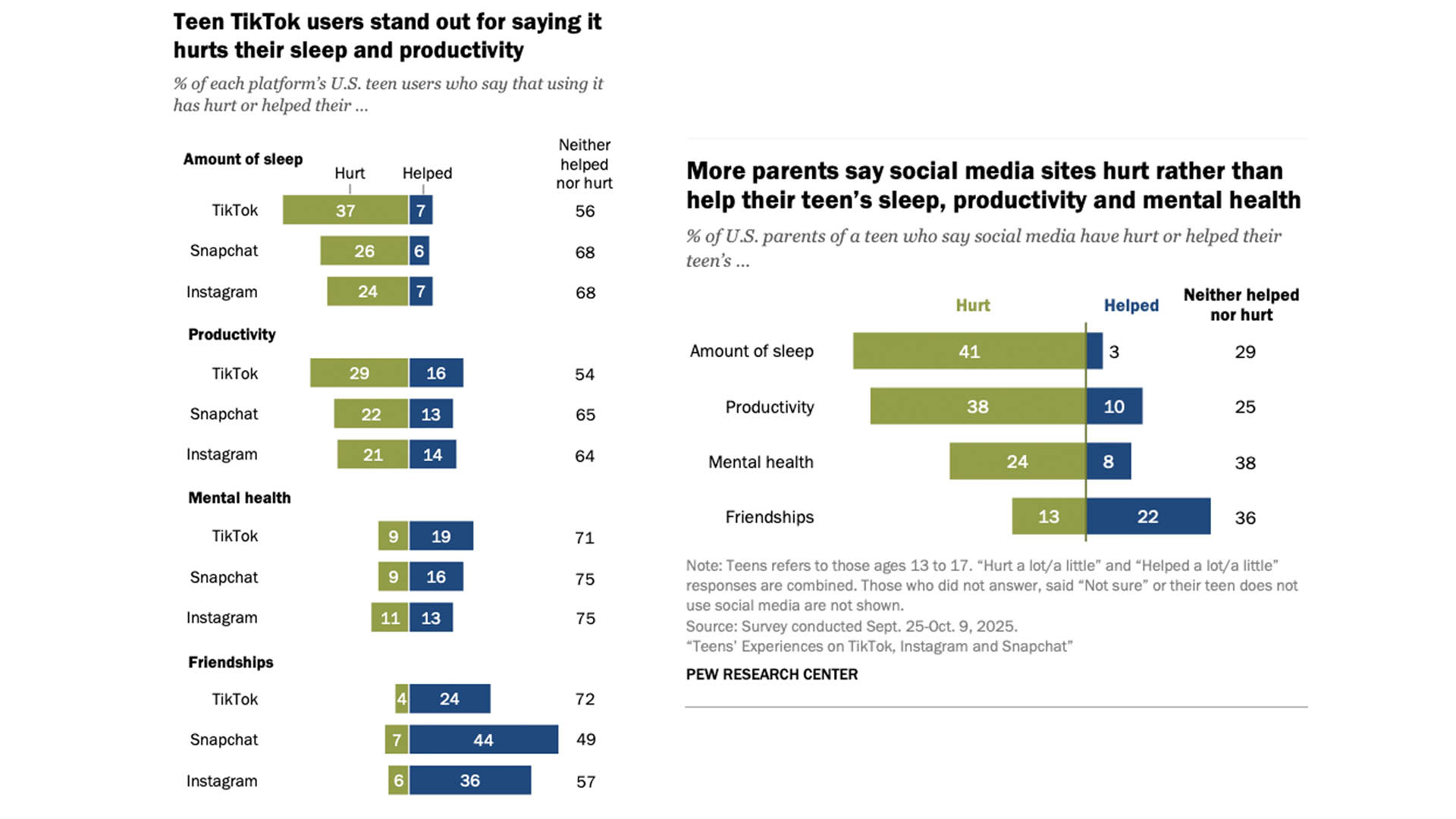
Most teens in the United States say that Instagram, TikTok and Snapchat aren't harming their mental health, though a slightly higher proportion report negative effects on their sleep and productivity, according to a new report from Pew Research. The report offers fresh insights into how teens perceive the effects of social media at a time when there are increasing calls to ban younger teens from social platforms altogether.
The report is based on a survey of 1,458 teens between the ages of 13 and 17. Teens were asked about their use of Instagram, Snapchat and TikTok and how those apps affect them. Pew also asked the teens' parents to weigh in.
Relatively few teens reported negative mental health effects, with 9 percent of Snapchat and TikTok users and 11 percent of Instagram users saying they thought the services had hurt their mental health. More teens reported negative effects on sleep and productivity, however, especially when it comes to use of TikTok. Thirty-seven percent of teens said their use of the app had hurt their sleep and 29 percent reported that it had affected their productivity. Even so, the majority of teens responded that the apps had "neither helped nor hurt" their mental health, sleep or productivity.
A significant number of teens did say that social media apps had helped their friendships, particularly Snapchat. At the same time, the app had a "somewhat higher rate" of bullying and harassment compared with the other services.
While the self-reported data is hardly a definitive answer to whether social media is harming teens, the numbers do offer a somewhat different narrative than the one that lawmakers, regulators and other critics have used to pursue social media bans and civil litigation against major companies. Meta, Snap and TikTok are all facing lawsuits that claim the platforms have purposefully created addicting features and enabled other harms to teen users,
Perhaps unsurprisingly, when researchers surveyed those same teens' parents, they had a more negative view of the apps' impact on their children. About four in ten parents said that social media hurts their kids' sleep and productivity and about a quarter thought it hurt their mental health. Forty-four percent of parents whose teens use TikTok said they thought their child was spending "too much" time in the app.
"The share of parents who say the same of Snapchat and Instagram is lower," the researchers note. "But the same pattern continues for both, with parents being more likely than teens to describe their teens’ use of these sites as excessive."
The report isn't the first time Pew has polled teens on their relationship with social media. Last year, a separate report found that teens were becoming more worried about social media, though they were less likely to say they had been negatively impacted on a personal level.
This article originally appeared on Engadget at https://www.engadget.com/social-media/most-us-teens-say-tiktok-instagram-and-snapchat-arent-hurting-or-helping-their-mental-health-140000912.html?src=rss
Adobe's Firefly AI Assistant works across Photoshop, Premiere and other apps
15 Apr 2026, 1:00 pm by Steve Dent
Few creative software companies have embraced AI like Adobe, with the company embedding image, video, audio and vector generation tools into nearly all its apps. Now, Adobe is taking on AI apps like Gemini's Nano Banana with its new prompt-based Firefly AI Assistant. You simply describe the outcome you want and it will execute "complex multi-step workflows" across Photoshop, Premiere, Lightroom, Illustrator and other apps to achieve that result, Adobe says.
The complexity of apps like Photoshop creates a "barrier to entry" for users who may have a vision but lack skill, according to Adobe. That's where the FireFly AI Assistant comes in. It works much like ChatGPT and other prompt-based AI assistants, but it has Adobe's suite of powerful apps behind it to execute the required steps. "You no longer have to map the process. You can start from the outcome," the company says.
Adobe emphasizes that while the Firefly AI Assistant is doing the grunt work, you remain in control. "You stay in the loop as the assistant executes, stepping in at any point to guide direction, adjust outputs and create something that's distinctly yours." It also maintains Adobe's native file formats, so the final output remains fully editable.
You'll be able to launch complex workflows with Creative Skills that let you run multi-step workflows from a single prompt, then customize them to your working style. For instance, you can start with the "social media assets" skill then direct the assistant to crop or use Generative Extend to make it fit the format of Instagram, Facebook and other platforms.
It can also handle context-aware creative decisions. In one example, Adobe describes a product photo set in a forest. "The assistant might give you a simple slider to increase or reduce the surrounding trees and foliage — making it easy to adjust the scene without complex edits," the company explains. Finally, to gather and act on feedback, the Assistant can organize and share work among team members via Adobe's Frame.io.
Adobe emphasizes that Firefly AI Assistant is grounded in the company's pro-grade creative tools to deliver "precise, context aware results" in a way that other AI agents can't and will learn your style over time. That's an argument the company no doubt hopes will counter a narrative that generative AI apps like Nano Banana are "eating software" like Adobe Photoshop. Adobe's Firefly AI Assistant will arrive in public beta in the coming weeks.
Should you wish to use other AI image generator within Adobe apps, the company has added Kling 3.0 and Kling 3.0 Omni, "all-purpose video models optimized for fast, high-quality production with smart storyboarding and audio-visual sync." That's on top of other models already offered, including Google's Nano Banana 2 and Veo 3.1, Runway Gen-4.5, Luma AI’s Ray 3.14, ElevenLabs’ Multilingual v2, Topaz Lab’s Topaz Astra and others.
This article originally appeared on Engadget at https://www.engadget.com/apps/adobes-firefly-ai-assistant-works-across-photoshop-premiere-and-other-apps-130055883.html?src=rss
Amazon's budget-friendly answer to the Frame TV will start shipping on April 22
15 Apr 2026, 1:00 pm by Cherlynn Low

When Amazon introduced the Ember Artline TVs in January, it didn’t have a specific date of availability to share. Now, the company is ready to supply the details: Pre-orders open today, and units ship on April 22 in the US and Canada, “with the UK and Germany to follow.” The company also announced a new version of its Fire TV Stick HD this morning, as well as some new features for its Fire TV software.
For those who don’t remember offhand, the Ember Artline is basically Amazon’s answer to Samsung’s Frame TV. It’s a matte, 4K QLED panel that can double as artwork when you’re not watching TV, and to that end, Amazon is including more than 2,000 pieces of art for free. That’s also part of the Fire TV package that comes on the new Fire TV Stick HD, so you don’t necessarily need an Ember Artline to access them.
In its press release, Amazon said “Our collection spans artistic movements and includes Impressionist classics by Monet, Degas, and Renoir, alongside contemporary works of street art, murals, mixed media, and photography. Customers also have access to 60 exclusive motion video pieces commissioned by documentary filmmaker Sam Nuttmann, who traveled the world capturing landscape and wildlife scenes.”
To make it easier to match the Ember Artline to your room’s decor, there are 10 frame color options to choose from, and the varieties I saw (a faux wood grain and a muted teal metallic finish) looked quite pleasant. If you really want some help finding artwork that will fit your space, Amazon’s “Match the room” feature might come in handy.
At a recent demo, I watched as the company’s representatives scanned a QR code from the TV to pull up the tool on their phone. There, they took three photos of the environment (surrounding walls and furniture, for example) and the system generated suggested pieces of art from the gallery. Using the TV remote, they were then able to choose from the recommendations on the big screen.
In my brief experience, the suggestions were typically quite good at matching the vibe, while offering a variety of styles (geometric, landscapes, modern etc) each time. According to the press release, “the AI tool will suggest artwork from our collection based on the room's colors, overall style, and any recurring themes in their existing artwork, including nature or travel photography.”
If you’d like a more personal touch, you can showcase your own photos instead by connecting your Amazon Photos account. You can also ask Alexa+ to
“play a slideshow of us biking in the mountains,” for example, to pull up memories ad hoc.

That’s not the only new feature coming to the Fire TV ecosystem, by the way. In addition to adding Alexa+ support and the new Fire TV UI it showed off in January, Amazon said that this month, it’s “adding another tool for US customers to seamlessly transfer a show or sports game by asking Alexa to move the content to another enabled Fire TV device in your home.”
So say you started watching a show in your bedroom and wanted to continue on the bigger screen in your living area. You could say “Alexa, move this to the living room.” The demo I saw took place on two Ember Artline TVs on adjacent walls, so the speediness was quite noticeable.
After the VP for Fire TV Aidan Marcuss asked the assistant to move the content over, the second TV picked up where the first left off in just about a second or two. Maybe real-world performance may vary but I can't imagine dashing from my bed to my couch in under three seconds just to avoid missing precious moments of The Boys drama.
For now, the feature is limited to Prime Video content, and Amazon said it plans “to roll it out to more services over time.”
The Ember Artline comes in 55-inch and 65-inch sizes and starts at $900. For context, Samsung’s The Frame (not the Pro versions) is available as a 32-inch model that costs $600, while the 65-inch configuration starts at $1,100 at the moment.
This article originally appeared on Engadget at https://www.engadget.com/home/home-theater/amazons-budget-friendly-answer-to-the-frame-tv-will-start-shipping-on-april-22-130000337.html?src=rss
Amazon's new Fire TV Stick HD is slimmer than ever and has no power adapter
15 Apr 2026, 1:00 pm by Cherlynn Low
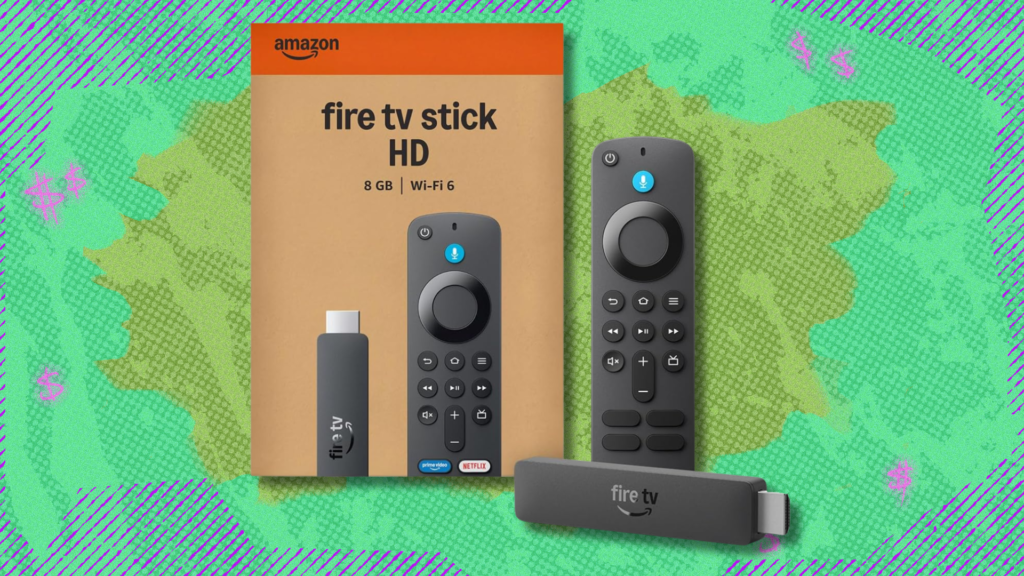
After unveiling a 4K version of its Fire TV Stick Select at its hardware event last September, Amazon is launching the latest version of its HD dongle today. The Fire TV Stick HD costs $35, comes with Alexa+ built in and offers the redesigned experience that the company previewed at CES in January. It might be confusing, considering Amazon makes at least five different configurations of its streaming stick, but the model announced today comes in at the entry-level and brings some meaningful upgrades.
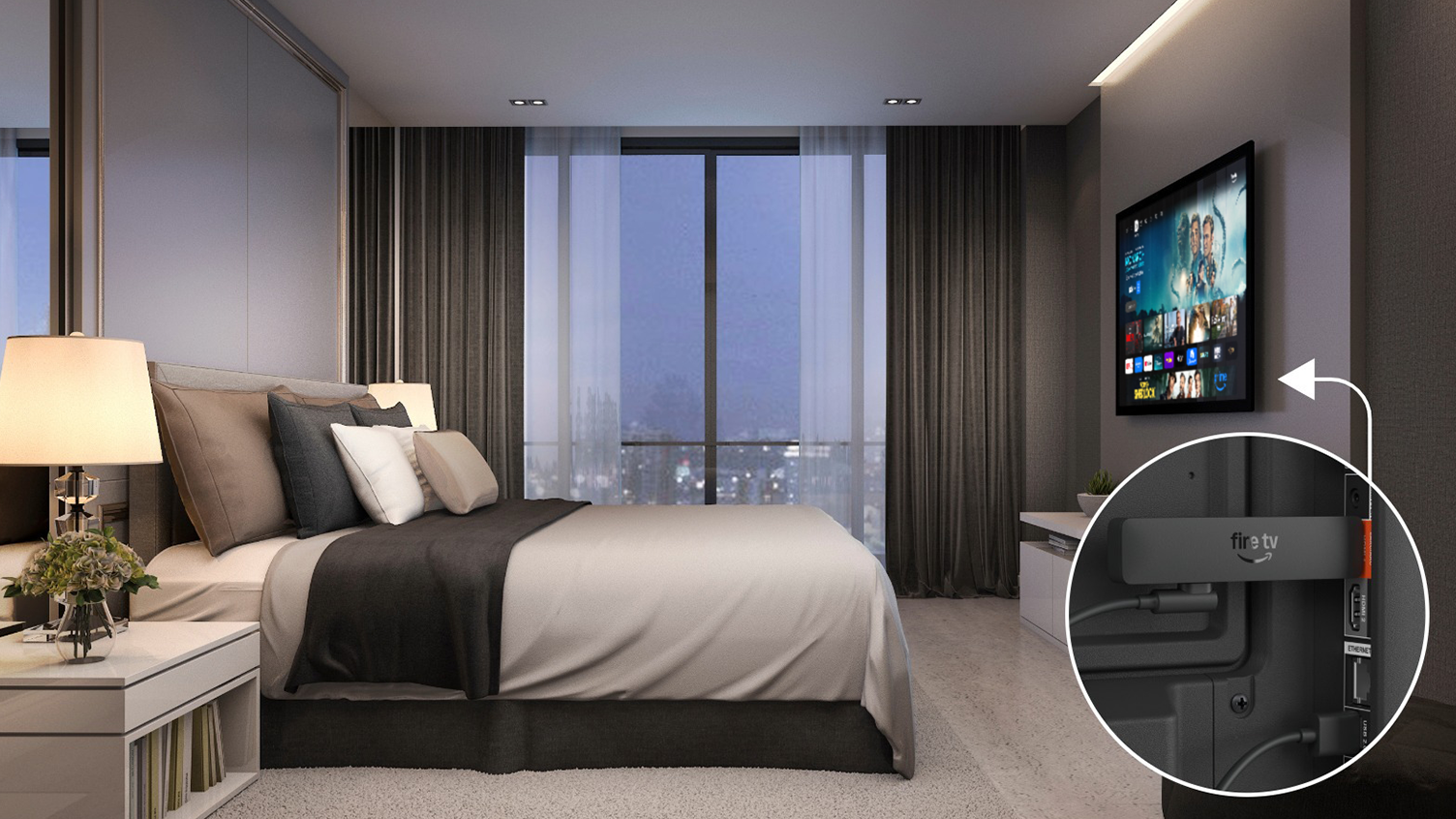
First, it’s about 30 percent narrower, according to the company, which makes it easier to fit into tight spaces (or to wedge between your TV and wall, perhaps). It comes with a short USB-C cable with a USB-A head that plugs into one of the USB ports on your TV, allowing it to draw power without the typically longer cables that would connect to wall adapters. To quote the company, the new Fire TV Stick HD is “optimized for Direct Power through a TV’s USB port, so it fits more neatly behind a TV without requiring a separate power adapter.”
But if your TV doesn’t have a USB port for that, you can still use a USB-C cable with a traditional wall adapter to power the new Fire TV Stick HD. Given how little power the USB ports on a TV provide, it's likely any old charger will do.
The new dongle also comes with other improvements like support for Wi-Fi 6 and Bluetooth 5.3, and Amazon says it’s “more than 30 percent faster on average” compared to its predecessor, “which means it turns on and opens apps more quickly.” That, together with the redesigned layout, should make it easier to find what you want to watch.
And if you’re a Prime Member or subscribed to Alexa+, you can also ask the assistant for show recommendations, dim your lights or pick up where you left off on a Prime video in a different room, if you have a compatible TV set in there.
Amazon also said that “in the coming months,” it will add a “new Adaptive Display setting to the Fire TV Stick HD.” This is supposed to be an accessibility feature that makes onscreen elements like words, menus and images easier to see. The company said that it would proportionally scale content artwork while enlarging text and menus, so the overall experience is “more balanced.” Multiple size options will be available.

Like its predecessors, the Fire TV Stick HD is a pretty straightforward device that brings modern features to older TVs. At $35, it’s a relatively budget-friendly price, though we recommend springing for the 4K Max model if you have a bit more to spare. If not, the new Fire TV Stick HD will start shipping on April 29 to those in the US, the UK, Canada, Mexico, Japan, Australia and New Zealand, with more regions coming later.
This article originally appeared on Engadget at https://www.engadget.com/home/home-theater/amazons-new-fire-tv-stick-hd-is-slimmer-than-ever-and-has-no-power-adapter-130000885.html?src=rss
Godzilla goes to New York in 'Minus Zero' teaser trailer
15 Apr 2026, 1:50 am by Mariella Moon
Japanese entertainment company Toho has released a teaser video for Godzilla Minus Zero, the upcoming sequel to the award-winning film Godzilla Minus One. The teaser shows the famous monster next to the Statue of Liberty as it rampages across New York. Godzilla Minus Zero is set in 1949, two years after the events of the first film, and will be a direct sequel. You’ll see familiar faces from Minus One in the short trailer, as well, namely Koichi Shikishima and Noriko Oishi, two of the first movie’s main characters.
The kaiju flick was filmed specifically for IMAX with high-definition digital cameras. Even its audio was optimized for the massive screen’s immersive cinema experience. Minus One won an Oscar for Best Visual Effects, so expectations are high for this sequel. The good news is that this movie is also helmed by Takashi Yamazaki, who wrote, directed and oversaw the visual effects for Minus One. Godzilla Minus Zero is heading to cinemas in Japan on November 3 and in the United States on November 6 this year.
This article originally appeared on Engadget at https://www.engadget.com/entertainment/godzilla-goes-to-new-york-in-minus-zero-teaser-trailer-015029346.html?src=rss
End of today’s Engadget roundup.